
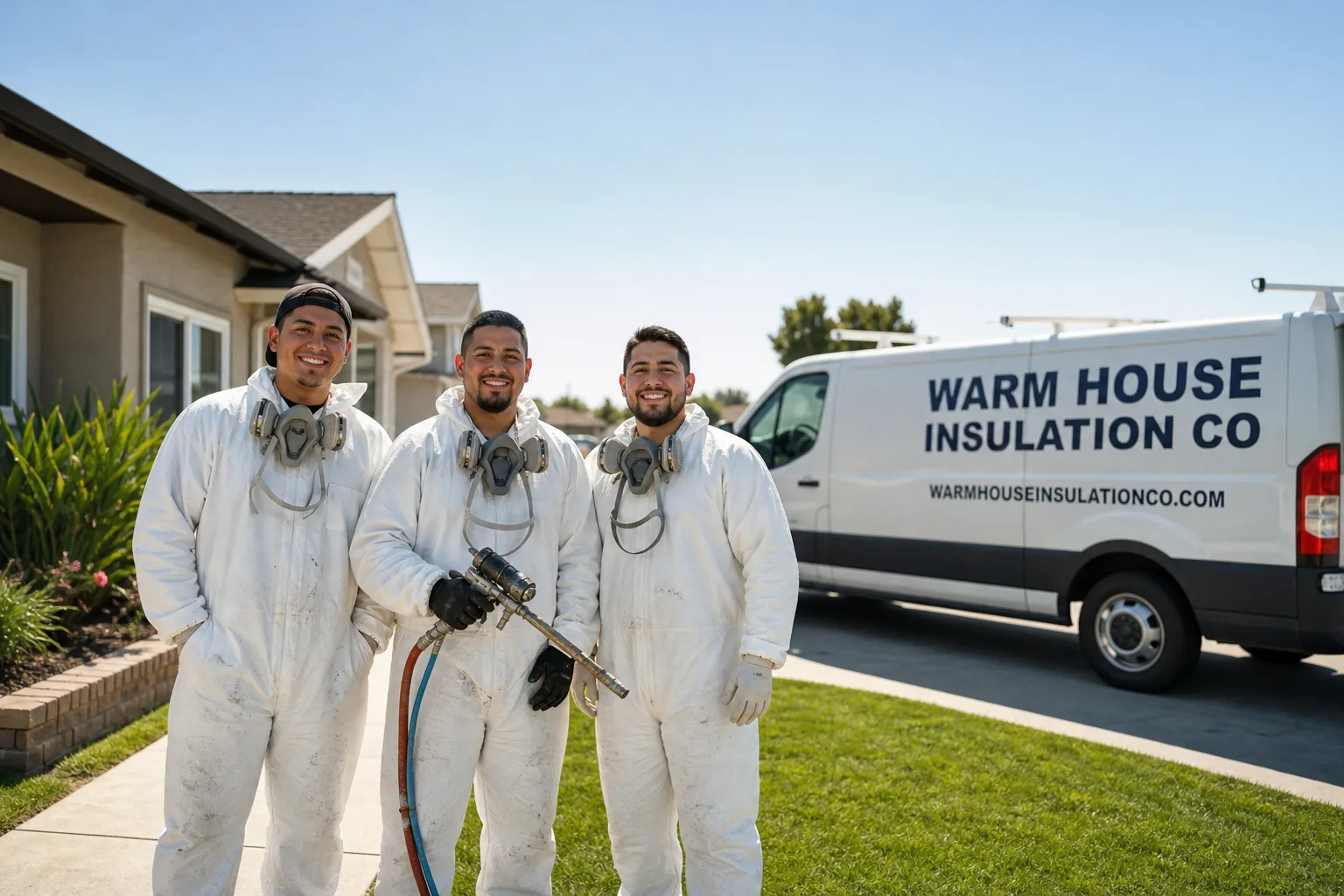
Fast, Reliable Spray Foam Insulation Across Good Hope
Spray foam insulation in Good Hope typically runs $1.50 to $3.50 per square foot for open-cell and $2.25 to $4.75 for closed-cell, with most single-zone jobs landing between $1,200 and $4,800 depending on scope. We serve all of Good Hope’s 92572 zip code, including the rural acreage parcels along the San Jacinto-Temecula corridor and the newer infill homes closer to Perris. Our crews come from Stanton, so we’re usually on-site in Good Hope within 45 to 60 minutes. Call (866) 361-3775 and we’ll walk you through what your attic, rim joists, or crawl space actually needs – no guesswork, no one-size-fits-all pitch.
Why Warm House Insulation Co Is Good Hope’s Preferred Spray Foam Insulation Company
Most Good Hope homes we see aren’t tract-style single attics. They’re older ranch houses on acreage, often with a detached workshop or garage sitting 40 feet away on the same parcel. That changes how insulation gets scoped, and it’s exactly the kind of job we’ve built our approach around. We carry both Icynene and Demilec spray foam systems, so when a Good Hope homeowner asks whether open-cell or closed-cell is right for a shed-turned-shop, we can answer from actual product knowledge, not from what happens to be on the truck.
Ruben Castellano leads our crews, and his directive is simple: diagnose the building, then choose the material. That’s why Good Hope homeowners call us back for second and third projects. We don’t push fiberglass because it’s easy. We don’t push foam because it’s trendy. We look at your attic depth, your rim joist condition, your venting, and the age of your framing, then tell you what makes sense. For a 1970s ranch off Ellis Avenue, that might mean closed-cell on the rim joists and a top-up of open-cell on the attic deck. For a new custom home near the Good Hope Community Center, the conversation could be completely different.
We also stock the materials to handle Good Hope’s specific summer reality. Attic temperatures here routinely blow past 140°F in July and August. Spraying foam into a superheated attic without first ventilating the space creates cure problems and off-gassing that nobody should live with. We plan for that, because we’ve done it enough times to know it’s coming.
Rim Joist Spray Foam in Good Hope
Rim joist spray foam is one of the most under-scoped jobs in Good Hope, especially on properties where a detached workshop or garage sits on the same parcel as the main house. The rim joist is the band of framing where your floor system meets the foundation wall, and in Good Hope’s older ranch homes, it’s often completely uninsulated. That leaves a direct path for 100°F-plus summer air to pour into the crawl space or basement, which then radiates up through the floors. Sealing those bays with closed-cell foam closes that gap. A typical rim joist job in Good Hope runs $900 to $2,400 depending on linear footage and access.
Why Closed-Cell Makes Sense Here
Closed-cell foam is the right call for most Good Hope rim joist work because it doubles as an air barrier and a moisture barrier. That matters when your crawl space was never conditioned and the ground moisture is a year-round presence. Open-cell won’t block that moisture the same way.
For detached workshops, the same principle applies. We frequently find rim joist bays in outbuildings that were simply skipped when the main house got insulated years ago. One trip, both buildings sealed.
When to Flag It
If you can see daylight at the top of your foundation wall from inside the crawl space, or if the floors above feel warm in summer even with the AC running, your rim joists are likely the culprit. Good Hope’s dry summer heat does not hide this problem, it announces it.
Crawl Space Spray Foam Insulation in Good Hope
Crawl space spray foam insulation in Good Hope has one distinct job: stop the superheated summer air that pushes through vented foundation walls from turning your entire floor system into a radiant heater. Many Good Hope homes sit on vented crawl spaces, which works fine in a mild coastal climate but becomes a liability out here where summer ground temperatures and air temperatures climb together. Sealing the crawl space perimeter and rim joists can drop under-floor temperatures by 15 to 20 degrees in peak heat. Budget $1,800 to $4,600 for a full crawl space encapsulation with closed-cell foam on the walls and rim area, depending on square footage and access height.
The Summer Heat Factor
Good Hope’s inland Riverside County climate means the crawl space doesn’t just get warm; it gets hot and stays hot for months. Traditional fiberglass batts in the crawl space ceiling absorb moisture, sag, and lose their R-value. Closed-cell spray foam on the crawl space walls flips the approach: you’re conditioning the space itself, not trying to insulate against it.
One important note from our Good Hope work: older homes here often lack a vapor barrier on the ground. That changes what we spec, because you can’t just foam the walls and ignore what’s rising from the soil. We lay the ground barrier first, then foam.
What Changes With a Detached Building
If you’ve got a workshop or garage with its own crawl space or slab edge, and that building was never insulated, that’s a separate scope. We price it as its own zone, but we do it on the same visit. You’re not scheduling two crews for two buildings.
Trusted Brands We Service in Good Hope
Warm House Insulation Co is authorized to install products from eight manufacturers: Owens Corning, Johns Manville, Knauf, Rockwool, CertainTeed, Icynene, Demilec, and GreenFiber. For spray foam specifically, we carry both Icynene and Demilec systems, which means Good Hope homeowners get a genuine choice between two of the most specified professional foam brands in North America. Brand choice changes by building. A detached workshop that bakes all summer might get Demilec closed-cell for its structural strength and low moisture permeability. A ceiling over living space might get Icynene open-cell for its sound dampening and slightly lower cost. We stock materials locally so turnaround for Good Hope jobs is measured in days, not weeks.
Common Spray Foam Insulation Problems We See in Good Hope Homes
- Open-cell foam on older attic decks without vapor barriers. A 1960s or 1970s Good Hope ranch house often has no vapor barrier between the attic and the ceiling plane. Open-cell foam applied directly to that deck can trap moisture against wood that was never conditioned to handle it, especially during the humid weeks in late summer. The fix is either a vapor barrier retrofit or switching to closed-cell in those zones.
- Rim joist bays in detached workshops skipped entirely. This is the most common scope gap we see on Good Hope acreage. A crew comes in, foams the main house attic, and the shop 50 feet away never gets touched because it wasn’t on the original quote. We scope both buildings on the first walkthrough.
- Off-gassing from foam sprayed into a superheated attic. When the attic is already 140°F or hotter, spraying foam into it without cooling or ventilating first causes cure problems. The foam skins over too fast, the chemical reaction accelerates, and the off-gassing is concentrated and harsh. We plan Good Hope summer jobs for early morning or use powered ventilation before we start.
- Inconsistent attic depth from previous blow-in jobs. Older rural Good Hope homes often got a thin layer of blown insulation decades ago, and it’s compressed to near zero in the center of the attic. Spray foam over an uneven substrate creates variable R-value. We level or remove the compromised material first where it matters.
Pricing for Spray Foam Insulation in Good Hope, CA
Here are honest numbers for the Good Hope market, based on what we’ve quoted for actual jobs in 92572. A standard attic spray foam job on a 1,200 to 1,600 square foot ranch runs $1,500 to $3,800 for open-cell, and $2,800 to $5,900 for closed-cell. Rim joist work runs $900 to $2,400. A crawl space sealing and insulation job typically lands between $1,800 and $4,600. Multi-building parcels, which are common in Good Hope, add the square footage of the workshop or garage attic as a separate line item, usually $1,200 to $3,000 for the outbuilding alone. We quote free, and we’ll walk the property with you before we put anything on paper. Call (866) 361-3775 for an exact number.
We Also Serve Cities Near Good Hope
Warm House Insulation Co handles Spray Foam Insulation work in Good Hope and the surrounding communities. You’ll see our trucks in Perris, Romoland, Sun City, and Mead Valley during any given week. If you’re just outside Good Hope on the San Jacinto-Temecula corridor, we’re already in the area. Call us and we’ll fit you into the same route.
Serving Good Hope, CA — Our Local Coverage Area
We’re based in the Good Hope area and know this community well. Use the map below to see our service coverage — if you’re nearby, we can almost certainly help.
FAQs About Spray Foam Insulation in Good Hope
Yes, and that’s standard practice for us. Good Hope’s acreage parcels mean most quotes involve two or more disconnected buildings, so we scope every attic, rim joist zone, and crawl space on the first walkthrough and do the work in a single trip. Call (866) 361-3775 and we’ll set up a time to walk your whole property, not just the house.
It gets removed where it matters. Compressed batt insulation from the 1970s or 1980s has lost most of its R-value, and spraying foam over it creates an uneven substrate and trapped debris. We pull the compromised material, air-seal the attic floor penetrations, and then apply the foam at the specified depth. The old stuff doesn’t help you, and leaving it in place causes more problems than it solves.
Yes. Good Hope’s vented crawl spaces get hot and stay hot for months, and traditional batt insulation in the ceiling sags and absorbs moisture. We recommend closed-cell foam on the crawl space walls to condition the space itself, and we always check for a ground vapor barrier first. Older Good Hope homes often don’t have one, and that has to go down before the foam does. Call (866) 361-3775 and we’ll explain the difference in person.
Closed-cell spray foam handles it best. It holds its R-value without sagging, adds structural rigidity to the framing, and doesn’t absorb moisture the way open-cell or batt insulation does. For a detached workshop or garage that bakes all day with no cooling, closed-cell on the roof deck or rim joists is the specification we recommend most often. It costs more up front, but in Good Hope’s heat it earns that back quickly.
We carry Icynene and Demilec, two of the most specified spray foam brands in North America. Brand choice does change by building. Open-cell Icynene is often the right choice for living space attics and interior walls where sound dampening matters. Demilec closed-cell is our go-to for rim joists, crawl space walls, and detached workshops where moisture resistance and structural strength matter more. Because we stock both, the recommendation is based on your building, not our inventory. Call (866) 361-3775 and we’ll walk you through the options for your specific property.
On a rural parcel off the San Jacinto-Temecula corridor in Good Hope, we foamed the rim joists and attic deck of a 1970s ranch house and then carried the same rig out to a detached workshop whose open-cell foam had been chewed back by years of 100°F-plus attic bake. We sealed the shop’s rim joist with Icynene closed-cell and re-flashed the house attic to a consistent depth, one trip for both buildings. The homeowner’s biggest relief was not scheduling a second crew for the outbuilding. That’s the way we scope every Good Hope job: whole parcel, all buildings, one visit.
Written by Ruben Castellano, Owner at Warm House Insulation Co, serving Good Hope and the San Jacinto-Temecula corridor.