
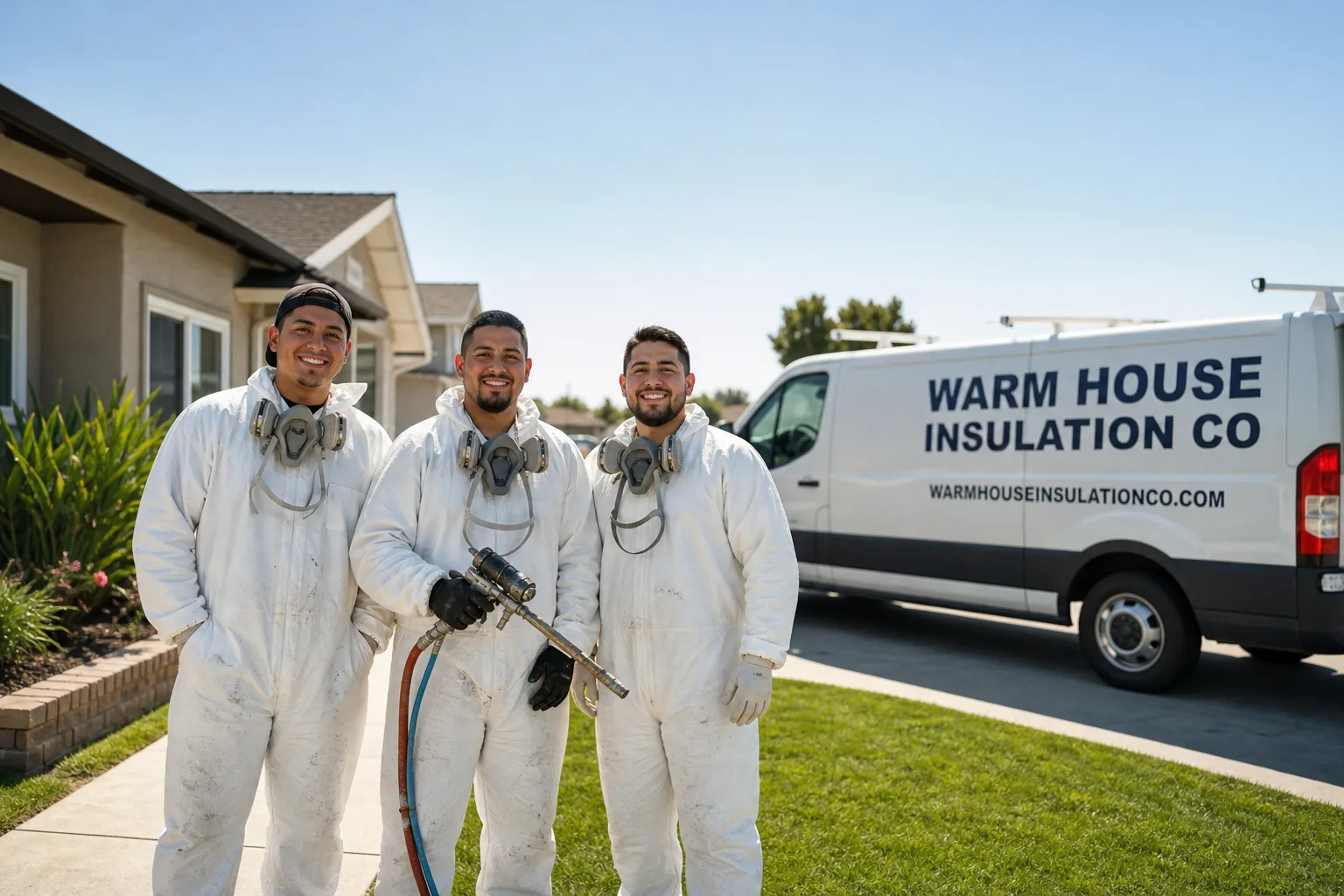
Fast, Reliable Spray Foam Insulation Across Highgrove
Spray foam insulation in Highgrove typically costs $2,200 – $5,800 for a full attic seal and runs one to two days on most ranch-style homes in the 92313 area. We work the acreage lots and mid-century neighborhoods off Center Street and Palmyrita Avenue every week, so we know what these homes need when temperatures climb past 100°F. If your Highgrove house was built before Title 24 energy standards kicked in, there’s a good chance your attic insulation has settled to a fraction of its original R-value. Our Spray Foam Insulation team is ready to fix that, usually within a few days of your call. Reach us at (866) 361-3775 for a free estimate.
Why Warm House Insulation Co Is Highgrove’s Preferred Spray Foam Insulation Company
Ruben Castellano leads Warm House Insulation Co with a diagnostic-first approach that matches the material to the home, not the other way around. That matters in Highgrove, where the housing stock runs heavily toward 1950s-to-1970s wood-frame ranches with original construction details that newer subdivisions don’t have. We carry both Icynene and Demilec spray foam systems, plus Rockwool mineral wool and GreenFiber cellulose for jobs where foam isn’t the only answer. Highgrove homeowners call us because we show up understanding what a scorching attic does to a ranch home’s cooling bill, and we bring the right product to seal it.
Crews reach Highgrove from our Stanton base quickly, often same-week, and we schedule around the heat when a job involves attic work. We also bring something most local installers don’t: eight authorized manufacturer lines means we’re not pushing whatever single brand happens to be on the truck. You get open-cell Icynene where a lighter, sound-dampening seal makes sense, closed-cell Demilec where higher R-value per inch and moisture resistance are the priority, and honest guidance between them.
Spray Foam Attic Insulation in Highgrove
Spray foam attic insulation in Highgrove addresses the single biggest energy-loss point in these older ranch homes: a thermal boundary that leaks cooled air into a 130°F attic space. Most homes here sit on larger lots with generous roof exposure and no shade, so the attic cooks all afternoon from June through September. When we open up a Highgrove attic, we frequently find the original R-11 batts compressed to two or three inches and gaps around recessed lights, plumbing vents, and the attic hatch where hot air pours straight down into the living space. Sealing that envelope with spray foam before adding insulation is what actually moves the needle on cooling costs.
Attic Floor Air-Sealing Before Foam
Applying foam over settled batts without first sealing the gaps wastes much of the upgrade. In Highgrove’s wood-frame ranches, those gaps add up quickly. We air-seal the attic floor first, then apply the foam so the R-value you’re paying for actually performs.
Duct Chases and Ceiling Penetrations
Old Highgrove homes often have can lights and bath fans that leak conditioned air into the attic. We foam-seal those penetrations as part of the attic job. That’s typically included in the $2,200 – $5,800 range we quote for a full Highgrove attic seal, depending on square footage and access conditions.
Spray Foam Wall Insulation in Highgrove
Spray foam wall insulation in Highgrove is a smart move for the area’s older ranch houses, many of which have empty or barely-filled wall cavities. In a typical 1960s wood-frame home off the rural acreage lots in 92313, the walls may hold a thin fiberglass batt with gaps at electrical boxes and corners, which means the afternoon sun loads heat straight through the studs by evening. Closed-cell Demilec foam injected into those cavities raises the wall R-value and acts as an air barrier in one application. It also stiffens the wall assembly, which older Highgrove homes benefit from.
Open-Cell for Interior Walls
For homeowners adding a home office or bedroom to a Highgrove ranch and wanting quieter spaces, open-cell Icynene works well in interior partitions. It dampens sound transfer between rooms without the higher cost of closed-cell. We spec it where thermal performance is secondary and acoustics matter more.
Closed-Cell for Exterior Walls
Closed-cell Demilec is the right call for Highgrove exterior walls facing the worst of the inland heat. At roughly $1.50 – $2.50 per board foot installed, it costs more than open-cell but delivers higher R-value per inch and resists moisture. On a 1,500-square-foot ranch wall retrofit, expect to spend $3,500 – $6,500 for complete cavity fill and sealing.
Trusted Brands We Service in Highgrove
We’re authorized to install spray foam from Icynene and Demilec, and we also carry Johns Manville and CertainTeed batt products plus Rockwool mineral wool for hybrid approaches. Highgrove jobs often call for a mix: closed-cell Demilec on the attic floor, Rockwool in the interior walls where fire resistance matters, and perhaps Johns Manville batts in a garage ceiling where foam would be overkill. Because we stock all of these lines, we can match the material to the situation rather than forcing one product onto every home. Parts and materials for Highgrove jobs are kept at our Stanton yard, so we don’t lose days waiting on supply runs.
Common Spray Foam Insulation Problems We See in Highgrove Homes
- Settled R-11 batts leaving gaping thermal holes. Most Highgrove ranches were built with R-11 attic batts that have compressed to a few inches over the decades. Without air-sealing those gaps, adding foam on top still lets 100°F+ attic air pour into the living space.
- Uninsulated duct runs bleeding cold air into a scorching attic. In a Highgrove attic that hits 130°F in August, an uninsulated or poorly insulated duct loses a huge share of the cooled air it carries. Foam-sealing the duct chases and the attic floor together is the fix.
- Minimal wall insulation in older wood-frame construction. Many 1950s-to-1970s Highgrove homes have empty or nearly empty wall cavities. Closed-cell foam applied correctly into those stud bays transforms comfort and cooling cost, but it has to be done with attention to moisture management in the wall assembly.
- Improper foam application trapping moisture in wall cavities. We’ve seen Highgrove homes where an earlier spray foam job didn’t account for the local climate. In a hot, dry inland environment, foam installed without proper depth control or mixing can trap residual moisture and cause problems down the line. That’s why method and brand matter more than price per board foot.
Pricing for Spray Foam Insulation in Highgrove, CA
Open-cell spray foam in Highgrove runs $0.80 – $1.40 per board foot installed, while closed-cell runs $1.50 – $2.50. A full attic seal on a typical 1,200 – 1,800-square-foot ranch home in 92313 lands between $2,200 and $5,800. Wall cavity retrofits range $3,500 – $6,500 depending on wall area and stud bay depth. Rim joist spray foam work at the foundation edge runs $1,200 – $2,400 for most Highgrove basements and crawlspace-adjacent spaces. What moves the number is access, square footage, and whether we’re doing attic and ducts in the same visit, which usually saves money over two separate trips. Call (866) 361-3775 for an exact quote. Estimates are free, and we’ll give you the number before any work starts.
We Also Serve Cities Near Highgrove
Our crews regularly work Grand Terrace, Colton, Loma Linda, and Rubidoux. Many of those neighborhoods share Highgrove’s older housing stock and the same inland heat issues, so we know the territory well. If you’re in one of those areas and dealing with the same scorching-attic problems, we can help there too. Highgrove homeowners often send us to family and friends in the next town over.
Serving Highgrove, CA — Our Local Coverage Area
We’re based in the Highgrove area and know this community well. Use the map below to see our service coverage — if you’re nearby, we can almost certainly help.
FAQs About Spray Foam Insulation in Highgrove
Because Highgrove’s older ranch attics leak air through gaps that batts can’t seal. Adding R-38 fiberglass on top of settled R-11 batts without air-sealing the attic floor first means you’re paying for insulation that hot air flows straight around. Spray foam seals the gaps and insulates in one step, which is why it delivers more comfort per dollar in these specific homes. Call (866) 361-3775 for an assessment of your attic’s current R-value and seal quality.
Yes, and we strongly recommend it on Highgrove homes with duct runs through the attic. Splitting the jobs means two trips, two mobilization charges, and a period where the other problem still leaks energy. We typically complete a combined attic-and-duct foam seal on a 1,200 – 1,800-square-foot ranch in one to two days. Call (866) 361-3775 to schedule a walkthrough and get a combined quote.
Yes, for most of the wood-frame ranches built in the 1950s through 1970s around Highgrove, closed-cell spray foam wall insulation is one of the highest-impact upgrades you can make. Injected into stud cavities, it stops the thermal bridging that hot afternoon sun drives through those thin, minimally-insulated walls. Expect to spend $3,500 – $6,500 on a full retrofit. Call (866) 361-3775 and we’ll inspect your wall construction and give you a firm number.
Highgrove’s homes mostly predate California’s modern Title 24 energy standards, which means they were built with minimal insulation and no air-sealing requirements. That changes how we approach the work: we’re not upgrading a mostly-efficient home, we’re bringing a 1960s ranch up to current performance from a much lower starting point. The job involves more sealing, more foam depth, and more attention to duct losses than a newer home would need.
Yes, we install both Icynene open-cell and Demilec closed-cell spray foam in Highgrove homes. Having both lines means we match the foam to your home’s specific situation: open-cell for interior sound dampening and cost-sensitive attic jobs, closed-cell where higher R-value per inch and moisture resistance matter. Call (866) 361-3775 to talk through which one fits your Highgrove ranch.
Written by Ruben Castellano, Owner at Warm House Insulation Co, serving Highgrove and the surrounding Inland Empire communities.