
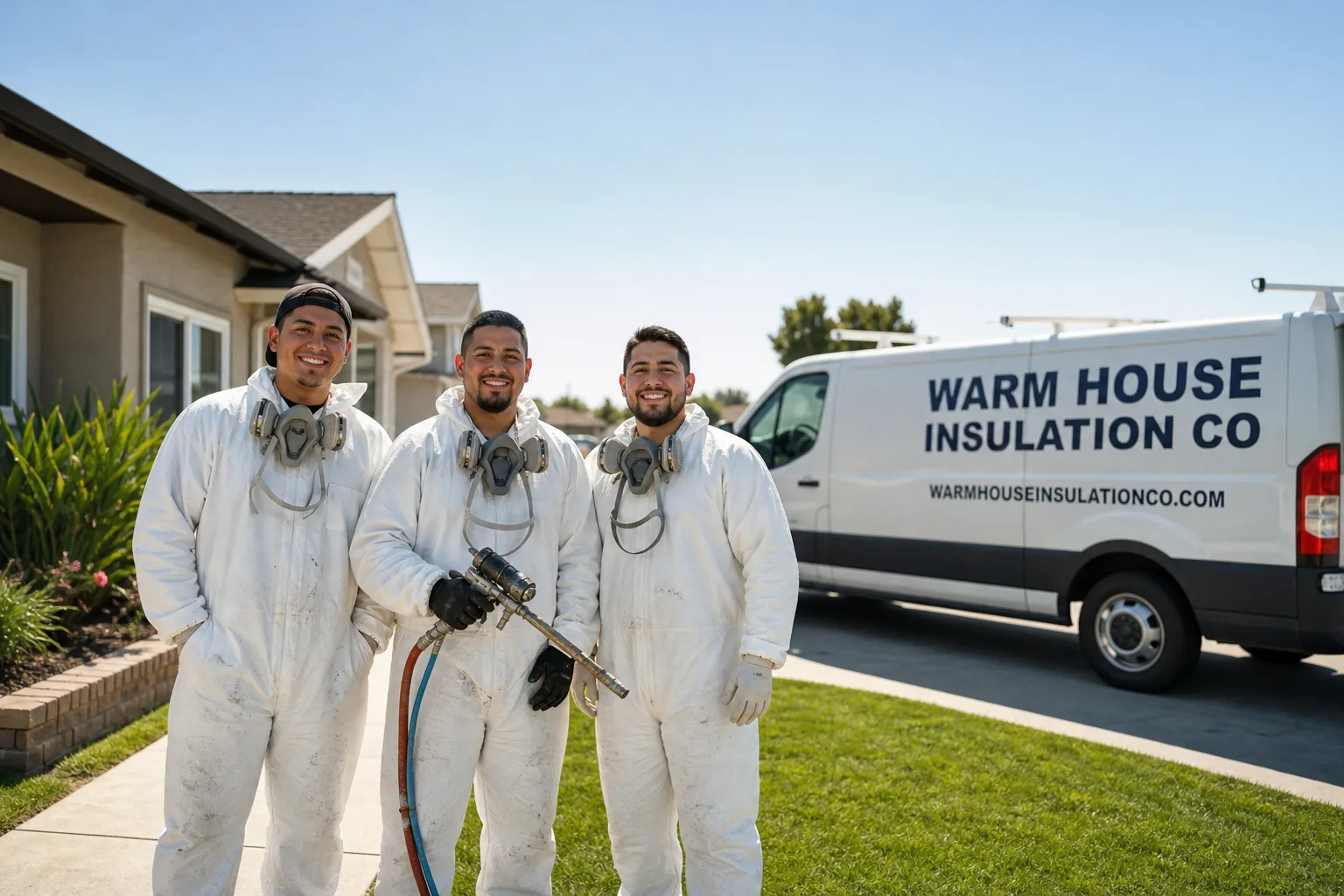
Fast, Reliable Spray Foam Insulation Across Northridge
Spray foam insulation in Northridge typically runs $2.50 to $6.50 per square foot installed, with most ranch-home projects landing between $3,800 and $9,000 depending on scope. We reach most Northridge neighborhoods within 60 to 90 minutes from our Stanton yard, so same-week scheduling is standard. If your attic hits 150°F in August or your garage bakes the bedroom above it, call (866) 361-3775 for a free estimate. We know the tract homes here, and we know what actually fixes them.
Why Warm House Insulation Co Is Northridge’s Preferred Spray Foam Insulation Company
Warm House Insulation Co has spent years working inside the low-pitch attics and garage conversions that define Northridge housing. These aren’t the roomy walk-up attics you see in newer builds; they’re tight, ductwork-crowded spaces where the wrong material or a rushed application fails fast. We carry both Icynene and Demilec spray foam systems, which means we can specify open-cell for sound attenuation in a master bedroom or closed-cell for a garage ceiling that needs structural rigidity and vapor control. Most contractors in the Valley stock one brand. We carry eight major manufacturers across our full insulation lineup, and that breadth changes the conversation from “what do you sell” to “what does this house need.”
Ruben Castellano leads our team with a diagnosis-first approach that has become our reputation in the San Fernando Valley. When a homeowner near Cal State Northridge calls about a bedroom that won’t cool below 82°F, we don’t just quote foam. We check the rim joist, the duct runs, the venting. We’ve worked on post-1994 earthquake rebuilds with modern framing and on original 1950s tract homes with sagging batts and odd air paths. Northridge is not a one-template town, and we don’t treat it like one.
The response advantage is real. We stage materials so our crews can be spraying foam in the 91324 and 91325 zip codes within the same week most homeowners call. For a garage that’s become unusable by 10 a.m., that speed matters.
Crawl Space Spray Foam Insulation in Northridge
Crawl Space Spray Foam Insulation in Northridge is not a routine add-on; it’s often the single highest-impact fix for homes with cold floors in winter and damp smells year-round. The dry Valley climate might make you think moisture isn’t a crawl space issue here, but the real problem in Northridge is thermal transfer through unsealed rim joists and vented crawl walls that let 100°F outside air move under the floor assembly. Closed-cell spray foam applied to rim joists and band areas stops that air movement and insulates in a single pass, which fiberglass batts physically cannot do when compression and air gaps are in play.
We most often recommend crawl space foam for homeowners who feel temperature swings between rooms on the first floor, or who’ve tried re-insulating walls and still see high summer cooling bills. Sealing the crawl space with foam also reduces dust intrusion, which matters in a dry region where fine Valley dust finds every opening.
Where Crawl Space Foam Pays Off Fastest
- Rim joist and band joist sealing: In a typical 1960s Northridge ranch, the rim joist is the largest uninsulated gap between conditioned air and outside heat. Foam seals it air-tight and adds R-value in one application.
- Floors over vented crawl spaces: When bedroom floors hover 8 to 12 degrees warmer than the living room in July, the crawl space is usually the culprit. Closed-cell Icynene or Demilec foam fixes the thermal break.
What Crawl Space Foam Costs in Northridge
Crawl space spray foam in Northridge runs $3.00 to $5.50 per square foot of applied area, with most rim joist sealing projects landing between $1,800 and $4,200. A full crawl space encapsulation with foam on walls and rim joists runs $6,000 to $14,000 depending on square footage and access. The good news: many ranch homes here have relatively shallow, accessible crawl spaces that keep labor costs moderate. Call (866) 361-3775 and we’ll give you a fixed quote after a single visit.
Garage Spray Foam Insulation in Northridge
Garage Spray Foam Insulation in Northridge is one of the most requested services we run, and for a very local reason: the classic California ranch layout puts the garage directly against the kitchen or a bedroom, and the shared wall plus garage ceiling become a giant radiator all summer. When that garage ceiling is uninsulated or has old R-11 batts sagging between joists, attic heat pours through. Closed-cell spray foam on the garage ceiling and the shared wall cuts that heat path dramatically. We’ve measured garage temperatures drop by 15°F to 20°F after a proper foam application.
On a 1962 ranch in the Sherwood Forest neighborhood, we sprayed closed-cell Icynene along the garage ceiling and shared wall to stop attic air from baking the garage and adjacent rooms. We sealed the rim joist and band areas where old fiberglass had sagged, cutting the garage temperature by about 15°F and reducing HVAC short-cycling. The homeowner noticed the difference in their home office above the garage immediately. That’s the kind of fix that repeats itself all over Northridge.
Garages Converted to Living Space
Northridge has a long history of garage conversions, some permitted, some not. If you’re converting a garage into a home office, gym, or ADU, spray foam is the only insulation that seals the overhead door framing and the surrounding wall cavities well enough to meet Title 24 air-sealing requirements while insulating. We’ve done enough converted garages in the 91330 and 91325 zip codes to know exactly where the air leaks hide.
Garage Ceiling Foam vs. Batts
In a low-clearance Northridge attic above a garage, fiberglass batts typically get compressed by foot traffic and storage, dropping them below R-19 effectiveness. Spray foam bonds to the sheathing and doesn’t sag, compress, or leave air gaps around recessed lights and junction boxes. For a garage that shares structure with the house, foam is the better call by a wide margin.
Trusted Brands We Service in Northridge
We’re authorized installers for Icynene and Demilec spray foam, the two most specified professional spray foam brands in North American residential work. We also stock Rockwool mineral wool for hybrid assemblies where fire resistance and sound control matter, and we carry CertainTeed and Knauf products for areas where fiberglass is genuinely the right material. That multi-brand depth means we’re not steering you toward the one product we happen to stock. If a Northridge attic needs open-cell for sound attenuation, we specify Icynene open-cell. If a rim joist needs moisture resistance and structural rigidity, we move to Demilec closed-cell. The brand follows the job, not the other way around.
Common Spray Foam Insulation Problems We See in Northridge Homes
Spray foam is a superior material, but Northridge has taught us exactly where it fails when applied badly or specified incorrectly. We fix and re-detail botched jobs regularly. Here are the four failure patterns we see most in this part of the Valley:
- Foam over sagging fiberglass in low-clearance attics: Too many crews spray foam directly over old, compressed batts without air-sealing the space first. The result is thermal bridging at every joist and a “sealed” attic that still pulls 140°F air through duct penetrations and can lights. We remove or bypass the old material and seal first, every time.
- Bad mix ratios from summer heat: Northridge’s July and August temperatures above 100°F change how foam components react. Improper proportioning during application causes off-gassing, poor adhesion, and foam that peels away from roof sheathing within months. We calibrate our rigs for ambient Valley conditions and test-spray before full application.
- Moisture traps in retrofitted garages: When a garage gets foam on the walls and ceiling without addressing ventilation, moisture collects at the wall-to-ceiling junction, especially where original vents were sealed during earthquake retrofits. We check attic and soffit venting before we ever pull the trigger on foam in a garage.
- Unsealed duct registers and top plates: In 1950s and 1960s Northridge ranches, the gap where interior walls meet attic framing is rarely sealed. Foam on the attic floor doesn’t stop that air path. We air-seal top plates, register boots, and plumbing penetrations before insulating so the foam layer actually does its job.
Pricing for Spray Foam Insulation in Northridge, CA
Here are real price ranges for Northridge work so you can budget honestly. Open-cell spray foam in an attic runs $2.50 to $4.00 per square foot installed. Closed-cell runs $4.00 to $6.50 per square foot. A typical low-clearance ranch attic of 1,200 to 1,800 square feet in Northridge lands between $4,800 and $9,500 for closed-cell, or $3,000 to $6,000 for open-cell. Garage ceiling and shared-wall foam work runs $2,800 to $6,000 on most ranch homes. Crawl space rim joist sealing runs $1,800 to $4,200. Crawl space full encapsulation runs $6,000 to $14,000. These are the numbers we actually quote in the 91324, 91325, 91327, and 91330 zip codes. Access, existing insulation removal, and attic ventilation work all shift the final figure. Estimates are free, and we never upsell foam where another material is the honest answer. Call (866) 361-3775 and we’ll come measure.
We Also Serve Cities Near Northridge
While this page focuses on Northridge, our crews regularly work in Northridge‘s neighboring communities. We serve North Hills, Encino, Van Nuys, and Valley Glen with the same-day scheduling and the same multi-brand Spray Foam Insulation specification depth. If you’re close to the Northridge line in any of those neighborhoods, the same team and same pricing apply without a travel premium.
Serving Northridge, CA — Our Local Coverage Area
We’re based in the Northridge area and know this community well. Use the map below to see our service coverage — if you’re nearby, we can almost certainly help.
FAQs About Spray Foam Insulation in Northridge
Yes, spray foam drops attic temperatures dramatically because it air-seals the attic from outside heat gain, unlike fiberglass batts which only slow heat transfer but leave air gaps. On a typical Northridge summer day when an uninsulated attic hits 150°F, a properly foamed attic stays within 10 to 15 degrees of the conditioned house temperature. The difference shows up immediately in lower cooling bills and rooms that stop drifting 8 to 10 degrees above your thermostat setting. Call (866) 361-3775 to schedule an attic inspection.
Yes, and that’s one of the highest-return foam projects in Northridge because so many ranch floor plans put the garage directly against the kitchen or a bedroom. We spray closed-cell foam on the shared wall, the garage ceiling, and the band joist areas to stop attic heat from moving through the garage into living space. Most homeowners see a 15°F to 20°F drop in garage temperature and a noticeable difference in the adjacent room within the first week. Estimates are free at (866) 361-3775.
Spray foam outperforms fiberglass in low-clearance Northridge attics because it bonds to sheathing and seals air paths that fiberglass can’t, and it doesn’t get compressed by foot traffic in tight spaces. A low-pitch attic with 24 inches of clearance at the peak simply can’t hold enough un-compressed fiberglass to hit modern R-value targets. Foam delivers R-6.5 per inch for closed-cell in half the depth, plus the air-sealing benefit. The premium over fiberglass typically pays back in cooling savings within 3 to 6 years in Northridge’s summer-dominant climate. Call (866) 361-3775 for a cost comparison on your specific attic.
Spray foam itself is non-conductive and safe around wiring, but older Northridge homes with original knob-and-tube or damaged cloth-insulated wire need an electrical inspection before foaming. Foam holds heat in wall cavities, and compromised wiring under insulation can overheat. We check for visible wiring issues in every attic and wall cavity before we spray, and we’ll flag anything that needs an electrician’s sign-off. We don’t cut corners on this in 1950s and 1960s tract homes where original wiring is common. Call (866) 361-3775 with any safety questions.
Closed-cell foam is the best crawl space choice in Northridge because it acts as a vapor barrier, adds structural rigidity to rim joists, and won’t absorb moisture from occasional winter rains or irrigation overspray. Open-cell foam can work in dry crawl spaces but needs a separate vapor control layer. For most Valley crawl spaces we specify 2 inches of closed-cell on rim joists and band areas, with optional wall foaming for full encapsulation. Pricing runs $1,800 to $4,200 for rim joist work on a typical Northridge ranch. Call (866) 361-3775 and we’ll quote your crawl space specifically.
Get Your Northridge Spray Foam Estimate Today
If your attic hits 150°F by noon in August, or a garage wall radiates heat into your kitchen all summer, the fix is one phone call away. We’re Ruben Castellano’s team at Warm House Insulation Co, and we’ve been solving exactly these problems across Northridge, North Hills, Encino, Van Nuys, and Valley Glen for long enough to know what works in a 1960s tract home and what doesn’t. Call (866) 361-3775 for a free estimate. We’ll measure, diagnose, and give you a fixed number, not a range that changes after the truck arrives.
Written by Ruben Castellano, Owner at Warm House Insulation Co, serving Northridge and the San Fernando Valley.