
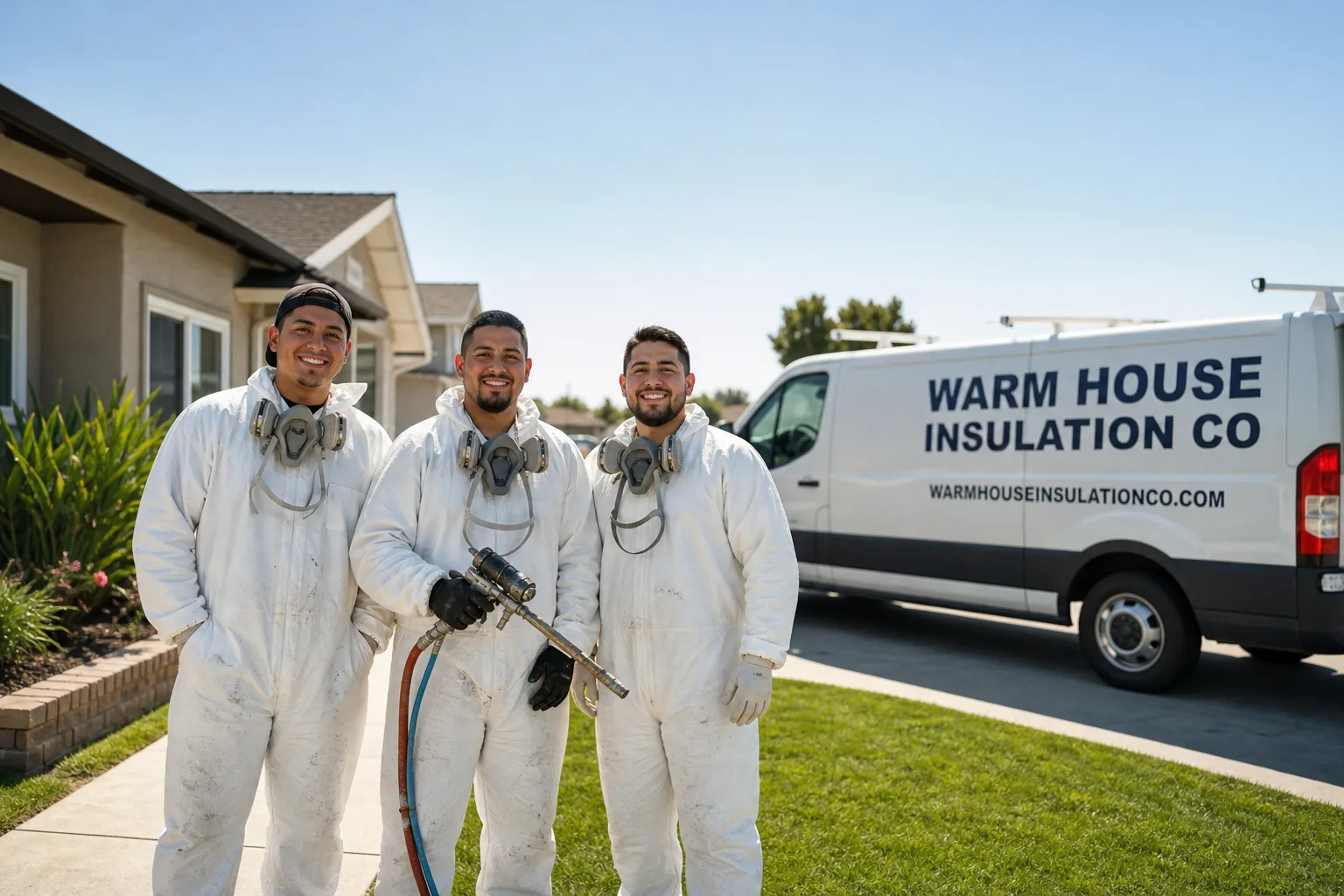
Fast, Reliable Spray Foam Insulation Across South San Gabriel
Spray foam insulation in South San Gabriel tackles two problems at once: it seals the air leaks that make summer cooling bills spike, and it fills the odd cavities left behind by decades of room additions on these narrow lots. Most jobs in the 91755 ZIP take one day, and our crews run the long hose paths from alley access points on a regular basis. If your attic clearance is tight or your lot opens to an alley instead of a driveway, call (866) 361-3775. Ruben Castellano and the Warm House team know how to stage a rig around South San Gabriel’s access puzzles without losing a clean pass against the roof deck.
Why Warm House Insulation Co Is South San Gabriel’s Preferred Spray Foam Insulation Company
We didn’t start as a spray-foam-only shop. Warm House Insulation Co carries eight manufacturer lines across every major insulation category because a 1957 South San Gabriel tract home with a low-clearance attic shouldn’t get the same recommendation as a newer infill build. Ruben Castellano built the company around matching the material to the house, not the house to the material. That means we specify Icynene open-cell where air sealing matters most, Demilec closed-cell where space is tight and R-value per inch counts, and Rockwool mineral wool where fire rating and sound control drive the decision. Most contractors in the San Gabriel Valley can’t offer that spread.
Our crews respond to South San Gabriel calls within the same window we serve Stanton and the surrounding basin. We know which blocks near Garvey Avenue and Muscatel Street have alley-loaded garages, which side streets pinch down to a single lane, and where a proportioner rig can actually park without blocking a neighbor’s gate. That matters before we ever quote a job, because the hose path determines how long the spray pass takes and how clean the finish looks.
We’re licensed and insured, and we stand behind every foam application with a clear scope before work starts. We don’t invent problems or upsell materials a home doesn’t need. If spray foam is wrong for a given attic, we say so and tell you why blown-in or mineral wool is the better call. That’s the whole point of being a Spray Foam Insulation specialist who also stocks alternatives.
Spray Foam Attic Insulation in South San Gabriel
Spray foam attic insulation in South San Gabriel is the highest-impact upgrade for these 1950s – 1970s stucco tract homes, because the original fiberglass batts have usually settled to two or three inches of near-useless R-value. We spray the underside of the roof deck rather than the attic floor. That moves the thermal boundary to the roofline, so the attic space itself stops acting like an oven that radiates heat through the ceiling all afternoon. Most attic applications in the 91755 ZIP run $2,400 to $6,800 depending on square footage, foam type, and how much prep the roof deck needs.
South San Gabriel’s heat changes the calculus here. Summer high temperatures regularly clear 95°F, and a roofline that isn’t air-sealed leaks cooled air out through every penetration while pulling hot outside air in. Open-cell Icynene does the sealing work well in ventilated attics. Closed-cell Demilec adds structural rigidity and a vapor barrier, which matters on low-slope sections where condensation risk climbs.
Low-Clearance Attics and Alley Access
Many South San Gabriel attics have less than three feet of clearance at the peak. That’s tight for a spray rig, and a wrong-angle pass can over-apply foam against the roof deck and choke the ventilation these homes depend on. Our crews map the hose path before quoting. If the lot opens to an alley rather than a driveway, we stage the proportioner at the back fence and run hose through a side gate or the garage.
Air Sealing the Roof Deck
Air sealing is where the energy savings actually come from. Foam applied to the deck seals around plumbing vents, electrical penetrations, and the irregular framing from old remodels. In South San Gabriel’s dense neighborhoods, we routinely find gaps where a second-story addition tied into the original roofline and nobody ever sealed the seam. That’s a year-round comfort leak.
Spray Foam Wall Insulation in South San Gabriel
Spray foam wall insulation in South San Gabriel usually means injection foam into stucco-over-wood-framing. These homes were built when nobody thought much about wall insulation, and the result is uninsulated bump-outs behind rear stucco walls, especially where a room addition was tacked on decades ago. Injection foam fills those cavities without tearing off the stucco. Typical wall injection work in South San Gabriel runs $1,800 to $5,200 depending on how many wall cavities are involved and how much mapping the framing requires.
The moisture risk is real here. Stucco is a reservoir cladding, and if you inject foam into a cavity that has a hidden leak path or poor drainage plane, you trap water against the sheathing. That’s how stucco blisters. Before we inject anything, we map the bump-outs, check the flashing at the top of each wall, and identify any cavity that should stay ventilated. This is why product breadth matters: in some walls, a dense-pack cellulose like GreenFiber is the safer call than foam, and warm, humid winter rains make that judgment important.
Bump-Outs and Room Additions
South San Gabriel is full of 1960s floor plans that someone extended out the back. Those additions almost never got insulated, and the framing is irregular – narrow bays, doubled studs, odd angles. We injection-foam those cavities from the interior or exterior depending on access, and the difference shows up immediately in rooms that baked every summer and shivered every winter.
Stucco-Safe Injection Methods
We use slow-rise injection foam for wall cavities because it expands gently and doesn’t bow the stucco outward. Older wood framing in these homes can’t handle the pressure of a standard two-pound closed-cell expansion. The slow-rise chemistry fills the cavity without stressing the studs or the plaster keys on the interior side.
Trusted Brands We Service in South San Gabriel
We install both Icynene and Demilec spray foam systems, and we’re also factory-authorized for Rockwool mineral wool and CertainTeed fiberglass when a home’s needs point in another direction. That means we stock the right material for South San Gabriel’s mix of old tract homes and newer infill before we show up, not after. If your attic needs open-cell Icynene for air sealing and your walls need injection foam with a slow-rise chemistry, we bring both to the same job. Most one-line contractors can’t say that. Ruben Castellano built Warm House this way on purpose.
Common Spray Foam Insulation Problems We See in South San Gabriel Homes
- Long hose runs from alley access. When a lot has no driveway, the proportioner rig has to park in the alley and hose has to run through a side gate or over a back fence. Unprotected hoses in the heat can let foam set mid-pass, which stalls the job and wastes material. We purge and protect our lines before the first spray.
- Low attic clearance causing over-application. A dense 1950s tract home near Garvey Avenue might have 30 inches of clearance at best. A wrong-angle pass can over-apply foam against the roof deck and block the airflow that a San Gabriel Valley summer needs. We mark our passes and check the ventilation gap before we spray.
- Uninsulated bump-outs behind original stucco. Room additions from the 1970s and 1980s rarely got wall insulation. The back bedrooms bake all afternoon and never hold temperature. Injection foam into those cavities fixes it, but the framing has to be mapped first or you get partial fills and cold spots.
- Moisture trapping in stucco-over-wood walls. If you inject foam without checking the drainage plane, you can trap water against the sheathing and blister the stucco months later. This is a real failure mode we’ve corrected on houses where another contractor skipped the prep work. We check flashing and cavity conditions before we inject.
Pricing for Spray Foam Insulation in South San Gabriel, CA
Attic spray foam in South San Gabriel typically runs $2,400 to $6,800. Wall injection work runs $1,800 to $5,200. What drives the spread: square footage, access difficulty, whether we’re working around alley staging, and whether the home needs open-cell or closed-cell chemistry. Closed-cell Demilec costs more per board foot but delivers roughly twice the R-value per inch, which matters in a low-clearance attic. Open-cell Icynene costs less and air-seals extremely well. We quote both options on every job so you can see the tradeoff in dollars and performance, not marketing language. Call (866) 361-3775 for a free estimate and a real number, not a range that shifts later.
We Also Serve Cities Near South San Gabriel
Our crews run regular routes to Spray Foam Insulation in South San Gabriel plus Monterey Park, Montebello, East Los Angeles, and Rosemead. If you live a block over the line in any direction, we already know the streets, the housing stock, and the access patterns. Same response time, same pricing, same crew who knows your ZIP code’s quirks.
Serving South San Gabriel, CA — Our Local Coverage Area
We’re based in the South San Gabriel area and know this community well. Use the map below to see our service coverage — if you’re nearby, we can almost certainly help.
FAQs About Spray Foam Insulation in South San Gabriel
Yes. Alley-only access is normal for us in the 91755 ZIP. We stage the proportioner in the alley or at the back fence and run hose through a side gate or the garage. Before we quote, we scope the hose path so the price account for the extra line length and the cleanup. Call (866) 361-3775 and describe your lot. We’ll tell you exactly how we’d stage it.
Yes. Injection foam goes into the wall cavity through small holes drilled from the interior or exterior, then the holes are patched. The stucco stays intact. On a 1960s stucco-over-wood-frame home near the Garvey/Muscatel corridor, our crew found uninsulated bump-outs behind the rear stucco wall where a room addition had been tacked on. We applied injection foam into those cavities without disturbing the original stucco, and the homeowner reported the back bedrooms held their set temperature through the hottest afternoons for the first time.
Because spray foam seals and insulates, but it doesn’t ventilate. In a South San Gabriel summer with daytime highs clearing 95°F, a sealed attic still needs proper airflow under the roof deck to keep shingle temperatures down and prevent moisture buildup. We check the ventilation gap before we spray and adjust the foam depth so we never choke the airflow. If your attic also has a radiant barrier, we account for that in the deck pass.
Yes, when the right chemistry is used. We use slow-rise foam for wall cavities in older wood framing because it expands gently and won’t bow the studs or crack the plaster. Closed-cell Demilec adds structural rigidity to the roof deck, which helps on older framing, but it has to be applied at the correct depth. Our crews are trained on both Icynene and Demilec systems, and they know the difference between a pass that seals and a pass that over-expands.
We mark our passes and use a shorter spray gun configuration when the peak is under three feet. The goal is full deck coverage without over-applying against the ventilation gap. Our crews work in these tight attics all over South San Gabriel, and we know where the irregular framing from old additions creates blind spots. Call (866) 361-3775 for a site walk. We’ll tell you if your attic is a straightforward spray or needs a different approach.
Written by Ruben Castellano, Owner at Warm House Insulation Co, serving South San Gabriel and the San Gabriel Valley.