Last updated October 31, 2026
DIY vs Professional Insulation: The Stanton Homeowner’s Decision Guide
Here’s a number that surprises most Stanton homeowners: roughly 30% of the insulation we remove during retrofit projects was installed by a previous owner as a DIY project. That’s not a knock on homeowner effort. It’s a statement about how many insulation jobs have hidden failure modes that don’t show up in a YouTube thumbnail. This guide draws the exact line between what’s genuinely doable on a weekend and what should never be attempted without training, equipment, and a contractor’s license. For related reading, see our How to Hire a Insulation Contractor in Stanton: A Step-by-Step Guide. You’ll learn which three specific jobs are DIY-viable in Stanton, why air sealing matters more than the insulation itself, and how the wrong choice can complicate your home sale years later.
Quick Answer
DIY insulation is genuinely viable for accessible attic top-ups over healthy existing material, open-wall batt replacements during renovation, and exposed basement rim joists in Stanton. Professional installation is non-negotiable for spray foam of any kind, any work near knob-and-tube wiring, full attic tear-outs, and crawlspace encapsulation. The single most expensive mistake isn’t a sloppy install – it’s adding insulation over existing material without air sealing first, which traps moisture under the new layer and creates a problem you won’t discover until a home inspection catches it.
Table of Contents
- The Real Divide: What Separates a Weekend Job from a Remediation Project
- The 3 Insulation Jobs That Are Genuinely DIY-Viable in Stanton
- The 4 Jobs Where Professional Installation Isn’t Optional
- Air Sealing: The Prerequisite Most Stanton DIYers Skip
- What You Can Buy at Retail vs. What Contractors Access Through Distribution
- California Rules That Affect Your DIY Insulation Decision
- What DIY Saves vs. What It Costs: A Stanton Reality Check
- Common Mistakes to Avoid
- When to Call a Professional
- Frequently Asked Questions
- The Bottom Line
The Real Divide: What Separates a Weekend Job from a Remediation Project
The DIY-vs-pro insulation conversation usually frames the decision as a skill question. It isn’t. The actual divide is about failure visibility. When you install a light fixture wrong, the lights don’t turn on. When you install insulation wrong, nothing tells you. The material sits inside a cavity, doing nothing, for years. You only find out through an energy bill that never dropped, a bedroom that never got comfortable, or a home inspection that flags your attic during escrow.
Stanton’s climate makes this failure mode worse than in many markets. Our summers push attic temperatures past 140°F routinely, and our winter nights hover in the mid-40s. Insulation that was installed lightly compressed, gapped, or with the facing pointed the wrong direction won’t announce itself. It just underperforms by 30-50%, which you experience as a PG&E or Southern California Edison bill that stays stubbornly high regardless of thermostat adjustments. In our experience walking through Stanton attics, the pattern is consistent: DIY batt work installed in a hurry performs noticeably below manufacturer spec, while blown-in work done by a homeowner with a rental machine often achieves near-professional density in open attics. The difference isn’t effort. It’s that some methods are forgiving and others aren’t.
This guide approaches the decision the way a Stanton homeowner actually experiences it: which jobs can you do this Saturday, and which jobs should you write a check for? For Insulation Cost Breakdown: The Stanton Homeowner’s Reference for 2026, see our dedicated pricing guide.
The 3 Insulation Jobs That Are Genuinely DIY-Viable in Stanton
Let’s be direct about what works. There are exactly three insulation scenarios where a competent Stanton homeowner with reasonable tool experience can achieve results close to professional grade. Outside these three, the risk curve bends sharply upward.
1. Accessible Attic Top-Over with Healthy Existing Material
If your attic has clear access, no signs of moisture damage, no rodent activity, and existing insulation that’s dry and functioning (even if below today’s R-value recommendations), adding loose-fill or unfaced batt layers on top is mechanically simple. The material sits in an open cavity with no cutting, no fitting, no enclosure work. The key errors are avoidable with a little reading: don’t cover soffit vents, don’t compress material, don’t bury can lights unless they’re IC-rated, and keep insulation three inches from any non-IC fixture.
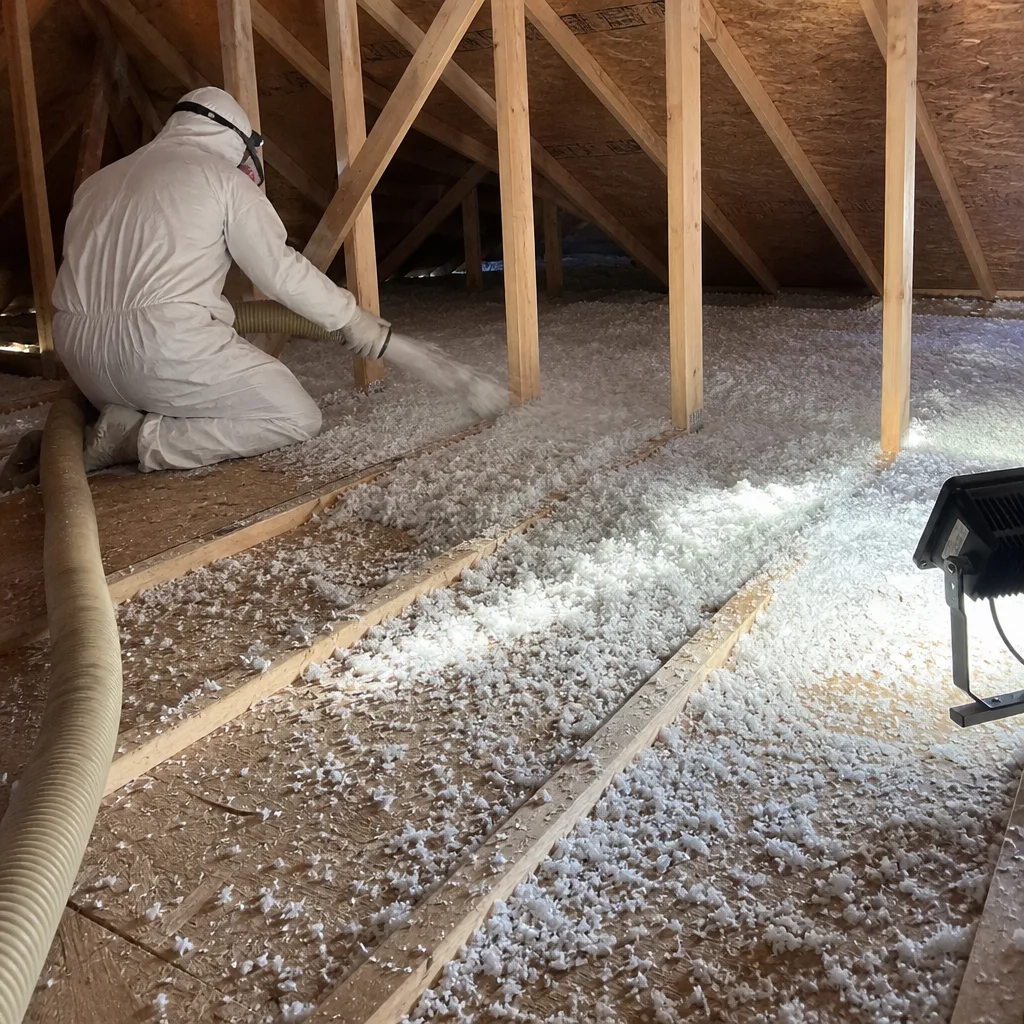
For Stanton homes built between 1950 and 2000, this is often the single highest-ROI insulation job available. Most of these attics have R-19 to R-30 fiberglass that was code-minimum at construction. Bringing them to R-38 or R-49 with a blown-in top-over reduces summer heat gain measurably in our climate. The work itself takes one weekend and requires a rental machine, a second person to feed the hopper, and basic PPE including a respirator, goggles, and long sleeves. The material of choice for DIY top-overs in Stanton is typically loose-fill fiberglass or cellulose. Both perform nearly as well in a homeowner’s hands as in ours, because the delivery method self-levels and the density target is easier to hit blind than it is with batts.
2. Open-Wall Batt Replacement During a Renovation
If you’ve already torn drywall down for a remodel, you’ve done the hard part. Fitting unfaced fiberglass batts or Rockwool mineral wool into an open stud bay is the most forgiving insulation task that exists. The cavity is visible, the dimensions are standard, and the material cuts cleanly with a utility knife. The professional difference here isn’t skill – it’s patience. A pro will friction-fit every batt perfectly, notch around electrical boxes, and leave zero gaps. A careful DIYer can absolutely match this.
This is also where product choice gets interesting. Most Stanton homeowners default to whatever fiberglass batt is cheapest at the big-box store. We carry Rockwool mineral wool precisely because its density and friction-fit characteristics make it more forgiving for imperfect installation. It holds itself in place, doesn’t slump, and adds meaningful fire and sound resistance that fiberglass doesn’t. If you’re doing this yourself, buy the rigid mineral wool rather than the soft pink stuff. The material cost is higher, but the performance margin covers the difference within one Stanton summer.
3. Exposed Basement Rim Joists
In Stanton homes with crawlspaces or partial basements, the rim joist area (where the foundation meets the floor framing) is a notorious air leak point. This is a common weak spot. Seal the rim joist from the inside using rigid foam board cut to fit each bay, then seal the perimeter with spray foam in a can or acoustical sealant. This is fiddly work: nineteen cuts, nineteen friction fits, and a lot of kneeling in a confined space. It is not technically hard, and the materials are cheap. A homeowner who takes one full day and works carefully can achieve the same result a professional crew would.
The DIY legitimacy here comes from accessibility and repair visibility. If you make a mistake, you can see it immediately and fix it with another bead of sealant. That’s what makes rim joists the rare insulation job where DIY risk is genuinely low.
The 4 Jobs Where Professional Installation Isn’t Optional
Now the sharp edge of the line. These four scenarios account for most of the botched DIY work and all of the chemical, fire, and structural hazards.
1. Spray Foam Insulation in Any Form
Spray polyurethane foam – whether Demilec or Icynene closed-cell or open-cell – requires a professional license to purchase at full strength, a professional rig to apply, and professional training to install safely. The two-component chemical reaction generates heat during curing, off-gasses during application, and requires exact ambient temperature and substrate moisture conditions to bond correctly. A homeowner cannot buy the same material at retail. What’s sold in consumer-grade spray cans and froth kits is chemically related but thermally and structurally inferior for whole-cavity applications.
This isn’t gatekeeping. The chemistry is genuinely unforgiving. Improperly mixed foam doesn’t cure, or cures brittle, or releases volatile compounds into your living space for months. We’ve been called to projects in Stanton where a homeowner attempted a two-part retrofit kit in a sloped ceiling and ended up ripping drywall off twice. The second time was our crew fixing both the failed foam and the moisture damage it introduced. Spray foam of any meaningful scale belongs to a trained crew. That’s true of every brand, including the two-class systems we carry as an authorized installer. For whole-attic or wall cavity work, spray foam insulation in Stanton is a professional material with professional requirements.
2. Any Project Within Reach of Knob-and-Tube Wiring
This is the one that should scare you. Stanton has a significant stock of pre-1950 homes. Many still have active knob-and-tube wiring buried in attic and wall cavities. Insulation installed over live knob-and-tube is a fire hazard. The wiring was designed to dissipate heat into open air. Encasing it in thermal insulation traps heat around ceramic tubes and cloth-wrapped conductors that are already seventy-plus years old. Insurance companies know this. Most carriers now require an electrical inspection before admitting DIY insulation work in historic homes, and some will deny coverage if they find insulation packed around live K&T that wasn’t professionally remediated.
Professional insulation contractors in Stanton work with electrical contractors to verify wiring type before material selection. We don’t proceed until that’s confirmed. A homeowner should not. The risk profile isn’t about craftsmanship: it’s about fire, and a fire that starts in an insulated attic burns slowly and hot before anyone notices.
3. Full Attic Tear-Out and Replacement
This is where “it’s just insulation” gets expensive. A full attic remediation involves removing old, possibly contaminated material (rodent waste, vermiculite, degraded fiberglass), often addressing mold or moisture issues first, air sealing the entire attic floor, correcting ventilation, and reinstalling material. This is a demolition, sanitation, and reconstruction sequence, and each stage has its own tools, permits, and disposal requirements. Vermiculite from pre-1990 attics sometimes contains asbestos. You don’t want to discover that halfway through a DIY removal with a rented vacuum.
Quotes for attic remediation in Stanton vary based on square footage, contamination, and access, but the final number almost always reflects the air sealing and vent work more than the insulation itself. Homeowners who attempt partial tear-outs rarely fix the underlying issues, which means they re-do the job correctly within two years. In our experience, attic insulation in Stanton replacement is a project where professional sequencing saves more money than the labor premium costs.
4. Crawlspace Encapsulation and Sealing
A full crawlspace encapsulation in Stanton involves installing vapor barrier material on the floor, running it up foundation walls, sealing all seams and penetrations, and often pairing it with a dehumidification system. The insulation component is only part of the job. This is environmental control work: you are changing the moisture dynamics of a space that’s connected to your home’s air column. Mistakes create standing-water conditions and mold growth that migrates into the living space. The materials are specialized, the physical labor is unpleasant, and the failure mode is a health issue rather than an energy bill.
Some homeowners attempt partial encapsulation: laying plastic on the floor and calling it done. That’s actually worse than doing nothing in many cases, because it traps ground moisture under the plastic while leaving the walls and rim joists unsealed. The space continues to breathe, but now the moisture concentrates at the edges. If your Stanton crawlspace is damp enough to consider encapsulation, treat it as a professional scope.
Air Sealing: The Prerequisite Most Stanton DIYers Skip
If there’s one concept this guide wants you to walk away with, it’s this: insulation resists heat transfer. Air sealing stops air movement. They are not the same thing, and doing the second without the first is a costly sequencing error.
Here’s what happens in a typical Stanton DIY attic top-over. The homeowner buys twenty bags of blown-in cellulose, rents the machine, blows it to depth, and packs up. Done. The attic now has R-49 material. Except the attic floor underneath that new material still has dozens of unsealed penetrations: wire chases, ceiling light boxes, plumbing vents, the attic hatch itself. Warm air from the living space continues to rise through those holes, now filtering through eighteen inches of insulation instead of six. That air carries moisture, and that moisture condenses inside the new insulation at the point where attic temperature meets living-space humidity. Within two years, the material compresses, the R-value drops, and mold spots appear.
The professional sequence is: seal every penetration with expanding foam or caulk, seal the attic hatch with weatherstripping, verify ventilation, then install insulation. This is the sequence we follow on every attic job in Stanton because skipping it invalidates the insulation. The irony is that air sealing is the cheapest and most skill-intensive part of the work. The materials cost pocket change. The expertise is knowing where the leaks are, what to seal with, and what not to seal (baffles, vents, combustion air intakes). A careful DIYer can learn this. A rushed one won’t bother. That’s the real test of whether your insulation weekend ends as a success story or as our remediation invoice.
For blown-in or batt-only work, blown in insulation in Stanton can absolutely include air sealing, but it needs to be a deliberate first step, not an afterthought.
What You Can Buy at Retail vs. What Contractors Access Through Distribution
An honest framing of the DIY utility gap starts with product availability. There’s a real difference between what’s on the shelf at Home Depot or Lowe’s and what a licensed contractor can pull from a supply house, and the difference isn’t always what marketing suggests.
Consumer retail insulation products are genuinely competent. Fiberglass batts from Owens Corning or Johns Manville in standard R-values are functionally identical to what a contractor installs in most residential wall cavities. Loose-fill fiberglass and GreenFiber cellulose sold in retail bales are the same materials that go through professional machines. If your DIY scope is a top-over or open-wall batt job, the retail channel serves you well. No meaningful quality gap exists there, and any contractor who tells you otherwise is selling.
The gap opens in three specific areas. First, high-density products: Rockwool mineral wool for interior partitions is increasingly available at retail in limited thicknesses, but the full product line (including comfortboard exterior insulation) stays in distribution. Second, two-component spray foam kits sold to consumers are chemically different from Demilec or Icynene systems applied by trained installers with proportioner rigs. The consumer kits use a different blend that cures at different densities and isn’t rated for full-cavity application. Third, specialized materials that are simply unavailable at retail: high-temperature tapes for vent sealing, the correct vapor barrier glue, baffle systems for non-standard rafter spacing. None of this is visible on a shelf.
The practical takeaway: if your project only needs materials you can identify and load into your own car, the retail-versus-pro gap is mostly a non-issue. If your project requires materials you’ve never heard of, that’s the distribution channel telling you the job is beyond retail scope.
California Rules That Affect Your DIY Insulation Decision
California’s Title 24 energy code governs what insulation can be installed in what climate zones, and Stanton falls under CA climate zone 8 (formerly 8 and 10 depending on the block, now consolidated), which sets specific R-value minimums for attics, walls, and floors. Here’s the thing most homeowners miss: Title 24 applies to remodel and alteration work, not just new construction. If you pull a permit for a renovation that includes insulation work, the inspector will hold you to current code minimums regardless of what was there before. Your existing R-19 attic becomes a non-issue until you touch it: once you alter it, code applies.
California also regulates material disclosure during home sales. Sellers must disclose any work done without permits, and insulation work that constitutes a “material alteration” without permit can complicate a transaction if it’s discovered. More practically, many home inspectors in Stanton now note the presence of amateur insulation work in their reports, especially uneven attic coverage or batt facing installed incorrectly. That note becomes a repair request or a price concession during escrow. DIY work that saved $800 in year one can cost $4,000 in a sale negotiation a decade later. For guidance on avoiding these scenarios, see our Insulation Emergency Preparedness Guide for Stanton Homes.
On the insurance side, some carriers post-Franklin Fire have tightened their underwriting. They’re asking about recent insulation work specifically when it involves spray foam, and some now require proof of a licensed installer for any foam application. We’ve had Stanton homeowners reach out specifically because their renewal was conditional on documentation of professional attic work. It’s a real thing, and it’s new enough that most DIY guides haven’t caught up.
One final California note: the state offers rebate programs through the utilities for insulation upgrades that meet specific verification criteria. Those rebates generally require a participating contractor and post-install verification. A DIY job won’t qualify. If you’re counting on rebate income to offset your material cost, you’re doing professional work by default.
What DIY Saves vs. What It Costs: A Stanton Reality Check
Let’s put numbers on the decision, because “hire a pro” is easy advice that ignores budgets. A standard 1,100-square-foot Stanton ranch attic top-over from R-19 to R-38 using blown-in cellulose will run roughly $650-$900 in materials and rental fees for a DIYer buying GreenFiber from retail. The same job done by a professional crew in Stanton typically ranges from $1,800 to $2,800 depending on access, air sealing work included, and existing conditions. The DIY savings is real: $1,100 to $1,900 on a typical home.
But here’s the offset. A professional job in that price range includes air sealing as a standard component, a uniform installed density verified by bag count, and disposal of whatever old material matters. A DIY job usually skips air sealing, which costs 20-40% of the energy benefit over the insulation’s lifetime, and may not hit target depth consistently. Over a ten-year period, a homeowner who does the job correctly saves more on energy than one who skips the sealing. Over a five-year period, the math can favor either.
For the two other DIY-viable jobs – open-wall batts and rim joists – the savings math is less favorable. Material costs are low for both, but the labor time is substantial and the contractor rates are already modest for this scope. A rim joist sealing on a Stanton crawlspace might cost $600 to $1,100 professionally. A DIYer will spend $150 on materials and most of a very uncomfortable Saturday. That’s a personal decision, not an obvious win.
The honest financial takeaway: attic top-overs represent the only DIY insulation job in Stanton with meaningful cost savings. Everything else is either too cheap to matter or too risky to attempt.
Common Mistakes to Avoid
- Blowing insulation over existing material without air sealing first. This is the number-one Stanton DIY failure. The new layer doesn’t fix the air leaks underneath, and moisture condensing inside the fresh material becomes a future mold or performance issue.
- Covering soffit vents. Attic ventilation depends on airflow from soffit to ridge. Burying the soffit vents under a new insulation layer kills that flow, raises attic temperatures, and turns your attic into a solar oven that cooks your new material.
- Compressing batt insulation to fit. Fiberglass and mineral wool batts work by trapping air. Compressing them to fit an odd cavity destroys the thermal performance. Cut them, don’t squish them.
- Installing a vapor barrier on the wrong side in Stanton’s climate. Southern California is a cooling-dominant climate. Vapor barriers belong on the warm, humid side: generally to the exterior in our climate zone, not the interior. Facing installed toward the living space in Stanton creates exactly the condensation problem you’re trying to avoid.
- Using spray foam cans for large-area work. Consumer cans are for sealing cracks and small gaps, not insulating stud bays. The cost per board foot is astronomically high and the unvented application with no training is exactly how amateur foam jobs go wrong.
- Ignoring recessed lighting clearances. Non-IC-rated fixtures cannot be in contact with insulation. In Stanton homes built before 2000, we commonly find these buried in DIY top-overs. It’s a fire hazard that home inspectors are trained to spot.
- Starting without checking for knob-and-tube. In any Stanton house built before 1950, entering the attic without first verifying what wiring is present is rolling dice with your family’s safety and your insurance policy.
When to Call a Professional
Call a licensed insulation contractor in Stanton when the job involves spray foam of any scale, attic tear-outs with potential contamination, crawlspace encapsulation, work near knob-and-tube wiring, or any project where you’re uncertain about the air sealing scope. Also call when the job needs to meet Title 24 documentation, when you’re applying for utility rebates, or when a home sale is on the horizon and you need professional work that won’t generate inspector flags. Warm House Insulation Co is a Stanton-based insulation contractor carrying eight product brands and all three installation methods, which means the material recommendation comes from your home’s actual needs rather than whatever single product line we happen to stock. We offer free estimates in Stanton – call (866) 361-3775 to schedule one.
Frequently Asked Questions
Yes, homeowners in Stanton can legally install insulation in their own primary residence without a contractor’s license, with the exception of most spray foam applications which require trained application due to chemical and fire-code considerations. Permits may still be required depending on scope, and work affecting structural cavities or involving electrical clearance should be reviewed against California building codes before you start.
On a typical 1,100-square-foot Stanton home, a DIY attic top-over saves roughly $1,100 to $1,900 compared to professional installation. That savings assumes you do the air sealing work correctly, hit the recommended depth, and don’t encounter contamination or wiring issues that change the scope. The savings is real for open attics with healthy conditions; it can go negative quickly if those conditions aren’t met.
No. The two-component systems used by professional installers – including the Demilec and Icynene product lines – are sold only through licensed contractor distribution channels and require specialized application equipment. The consumer aerosol and froth-pack products at retail are different formulations rated for small sealing jobs, not whole-cavity insulation work.
Current California Title 24 guidance for CA climate zone 8 (which covers Stanton) recommends R-38 to R-49 attic insulation for most existing homes depending on the structure and equipment. Many Stanton homes built before the 2000s have R-19 or less, which means the gap between your current performance and code guidance is likely substantial, and a top-over is the most direct way to close it.
It can, in either direction. Insulation work done carefully and properly will help: improved energy efficiency shows up on inspection reports and utility history. Amateur work that’s uneven, improperly faced, or packed around non-IC-rated lights or knob-and-tube wiring will get flagged during escrow inspections as a repair item or price concession. If you’re doing DIY work with a sale anywhere in the future, match professional standards.
Yes. We provide no-cost insulation assessments and estimates for Stanton homeowners, covering attic, spray foam, and blown-in scopes. Explore more guides & resources on our blog. Call (866) 361-3775 and we’ll walk your home with you, identify what’s actually going on in the attic or walls, and give you a straight answer on whether your project is a realistic DIY or should stay with a licensed crew.
The Bottom Line
The DIY-versus-professional decision in Stanton isn’t a referendum on your competence. It’s a question of failure visibility. Jobs where mistakes show up immediately – open-wall batts, accessible top-overs, rim joists – are reasonable DIY scopes if you respect the air sealing prerequisite and don’t rush. Jobs where mistakes hide inside a cavity or become a fire, moisture, or insurance issue – spray foam, tear-outs, knob-and-tube proximity, encapsulation – belong with a licensed crew. The most expensive decision is the one that looks cheapest: adding insulation over an attic that hasn’t been air sealed and waiting for the consequence to show up on a future inspection report.
Written by the team at Warm House Insulation Co, serving Stanton since 2011.