Fast, Reliable Spray Foam Insulation Across Koreatown
Spray foam insulation in Koreatown is the fastest way to stop upper-floor units from roasting through summer, especially in the neighborhood’s older apartment buildings and bungalows. We work throughout 90005 and the surrounding blocks, from Wilshire through Olympic, and we know exactly what those shallow vented attics and low-slope roofs do when LA temperatures hit 95°F. Warm House Insulation Co runs trucks into Koreatown daily from our Stanton base, so we’re usually at your building within a day of your call. For a free estimate on open-cell or closed-cell spray foam, call (866) 361-3775.
Why Warm House Insulation Co Is Koreatown’s Preferred Spray Foam Insulation Company
Koreatown is a different kind of insulation market. It’s not single-family suburban homes deciding whether to upgrade. It’s property managers and landlords comparing fire-rated and sound-mitigation bids across dozens of identical units in 1950s and 60s courtyard buildings. We’ve worked those buildings. We’ve pulled compressed fiberglass out of low-slope roof cavities near Western and 8th, and we’ve air-sealed fire-blocking walls in prewar bungalows off Vermont. That kind of building-by-building familiarity means we don’t arrive guessing at what’s behind the stucco.
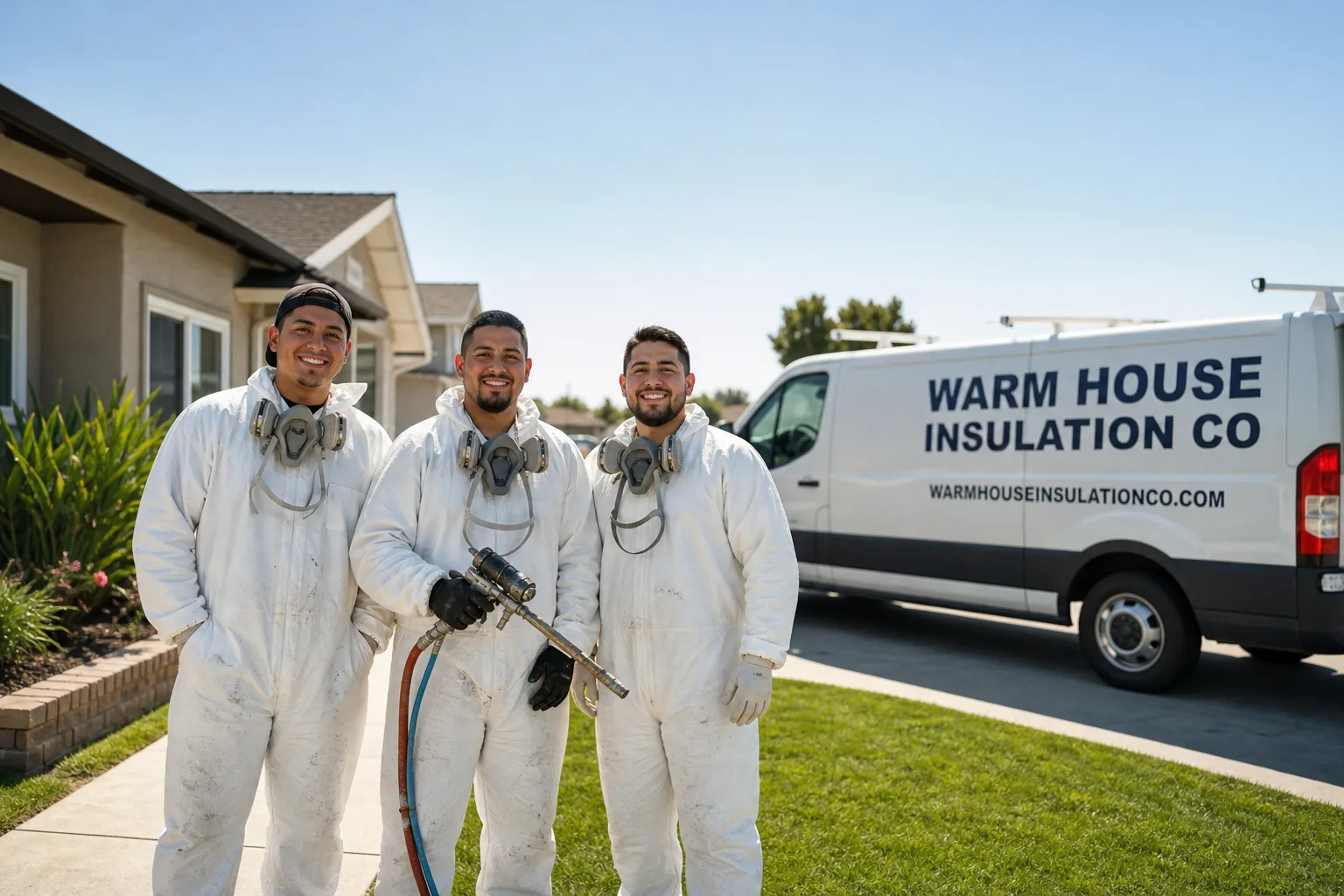
Ruben Castellano leads our spray foam crews, and he’s particular about diagnosing before quoting. When a property manager calls about top-floor heat complaints, we don’t just spray and leave. We identify where the attic is actually failing, whether that’s degraded legacy batts, bypasses at fire-blocking walls, or a venting problem that will trap moisture against new foam. Koreatown’s buildings are old enough that guessing wrong costs real money.
Spray Foam Insulation Contractors in Koreatown
Spray foam insulation contractors in Koreatown have to know the difference between a 1962 courtyard apartment and a 1925 wood-frame bungalow, because the failure modes are not the same. A typical spray foam job in Koreatown runs $2,900 to $6,500 for an attic or rim joist application in multi-family buildings, with smaller garage ceiling projects starting around $1,800. The work typically involves removing degraded material, air-sealing bypasses, and applying either open-cell or closed-cell foam to the roof deck or rim joist cavities.
Rim Joist and Garage Ceiling Work
Many Koreatown buildings have uninsulated garages directly beneath top-floor units. The shared garage ceiling is often the single biggest heat gain point in the whole structure. We spray closed-cell foam against the garage ceiling underside and rim joists, which blocks the stack effect that pulls hot garage air up into living spaces.
Unit-by-Unit Retrofit Without Full Vacancy
Most Koreatown property managers can’t empty a building to insulate it. We phase the work unit by unit, sealing off the attic access and working from the roof side where possible. That means tenants stay in place and the building stays occupied while the retrofit happens.
Spray Foam Attic Insulation in Koreatown
Spray foam attic insulation in Koreatown is aimed at the roof deck, because that’s where the heat enters. In buildings with shallow vented attics and low-pitch asphalt roofing, summer attic temperatures above 140°F bake whatever insulation is up there, and top-floor units run AC constantly. A spray foam attic job in Koreatown typically runs $3,200 to $7,000 depending on square footage, with the higher end covering removal of old compressed fiberglass and air-sealing work before the foam goes in.
The 140°F Attic Problem
On a 1962 courtyard building near 8th and Western, top-floor tenants ran AC nonstop because the original fiberglass batts over the shared garage had collapsed to less than an inch. We removed the degraded batts, air-sealed the fire-blocking walls, and applied Icynene spray foam to the underside of the roof deck, dropping attic temps by over 30°F and ending the constant cycling. The property manager then scheduled identical work on two more buildings on the same block.
Heat Rejection, Not Just R-Value
In Koreatown’s climate, the goal is stopping heat from entering the building in the first place. Closed-cell spray foam against the roof deck does that by creating an air and moisture barrier at the exact point where radiant heat loads are highest. Open-cell foam works too, particularly where sound dampening between units matters as much as thermal performance.
Trusted Brands We Service in Koreatown
We install both Icynene and Demilec spray foam systems, which matters because they address different problems. Icynene open-cell foam handles sound attenuation and air sealing in interior cavities, while Demilec closed-cell brings the higher R-value per inch and moisture resistance needed against roof decks and rim joists. We carry the full product lines for both, so Koreatown customers aren’t waiting on special-order materials when a building retrofit starts. Rockwool mineral wool is available too, for fire-code-sensitive walls where property managers want the added fire resistance that foam alone doesn’t provide.
Common Spray Foam Insulation Problems We See in Koreatown Homes
- Compressed legacy batts in 1950s-60s low-slope roofs. Original 1- to 2-inch fiberglass batts flatten behind asphalt roofing over decades, and at 140°F attic temps they degrade into near-zero R-value. Top-floor units become uninhabitable in summer until the old material is removed and replaced.
- Air bypasses at fire-blocking walls in prewar bungalows. Koreatown’s 1910s and 1920s wood-frame buildings often still have knob-and-tube wiring and unsealed wall cavities. If those bypasses aren’t sealed first, spray foam can’t perform, because hot air simply routes around it.
- Moisture trapping in shallow vented attics. Many stucco-clad multi-family buildings have attic spaces that don’t vent properly. Spraying foam without addressing ventilation can trap moisture against the roof deck, which shortens the life of both the foam and the sheathing.
- Unit-to-unit temperature imbalance. In three-story courtyard buildings, the top floor roasts while lower units stay cooler. The cause is almost always attic-level heat gain, and spray foam at the roof deck is the direct fix.
Pricing for Spray Foam Insulation in Koreatown, CA
Spray foam insulation in Koreatown runs $1,800 to $7,000 depending on what’s being sprayed and how much prep is involved. Garage ceiling and rim joist work sits at the lower end, roughly $1,800 to $3,200 for a typical multi-car under-building garage. Attic roof deck applications run $3,200 to $7,000, and that range accounts for removal of old fiberglass, air-sealing, and the foam itself. Closed-cell costs more per board foot than open-cell because it delivers higher R-value per inch and acts as its own vapor barrier. The condition of your attic, the age of the building, and whether fire-blocking walls need sealing all factor in. We quote each unit or building individually, and estimates are free. Call (866) 361-3775.
We Also Serve Cities Near Koreatown
Our Spray Foam Insulation crews cover the entire LA basin. Beyond Koreatown, we regularly work in Los Angeles, Echo Park, Silver Lake, and Hollywood, often same-day when the schedule allows.
Serving Koreatown, CA — Our Local Coverage Area
We’re based in the Koreatown area and know this community well. Use the map below to see our service coverage — if you’re nearby, we can almost certainly help.
FAQs About Spray Foam Insulation in Koreatown
No. Spray foam needs a clean, solid substrate to bond and form an air seal. Applying it over degraded fiberglass traps the old material in place and prevents the foam from sealing the roof deck. We remove the compressed batts first, inspect the sheathing, then spray directly against the roof deck or rim joist. That’s the only way the foam performs as an air barrier. Call (866) 361-3775 to schedule an attic inspection.
Spray foam stops heat at the point of entry, which is the roof deck. In Koreatown’s heat, that matters more than added R-value alone, because attic temperatures over 140°F cook conventional batts and force top-floor AC units to run nonstop. Closed-cell foam reflects and blocks radiant heat while sealing the air leaks that let hot attic air press down into living spaces. The result is a top floor that actually holds its temperature. For a heat-loss assessment, call us at (866) 361-3775.
Yes. We phase Koreatown multi-family retrofit work unit by unit, isolating the attic access point and sealing off the work area so tenants stay in place. We’ve completed identical retrofits across multiple buildings on the same block, which lets property managers spread the cost across units and avoid vacancy loss. Ruben Castellano schedules the phased work and keeps each unit dark no more than a day or two. Call (866) 361-3775 for a building-wide quote.
First, have the wiring inspected. Spray foam encases whatever is in the cavity, and knob-and-tube wiring that’s still live can overheat when foam blocks its natural air cooling. Second, seal the fire-blocking walls and any bypasses around chimneys or plumbing chases. If those air paths stay open, the foam can’t do its job. We coordinate with electricians on these older bungalows before we spray. Call (866) 361-3775 for guidance.
Yes, particularly with closed-cell foam against the roof deck. When you seal the attic from the living space, you’re changing how moisture moves through the building. Many Koreatown buildings have shallow vented attics that don’t move enough air, so pairing the foam with a ventilation upgrade prevents moisture from collecting against the sheathing. We assess the existing vents and recommend fixes before spraying. Call (866) 361-3775 for an attic evaluation.
Need spray foam insulation in Koreatown? Call Warm House Insulation Co at (866) 361-3775 for a free estimate. We’ll walk the building with you, identify the real heat problem, and quote the right fix, not the easy one.
Written by Ruben Castellano, Owner at Warm House Insulation Co, serving Koreatown since our first LA basin retrofit.