
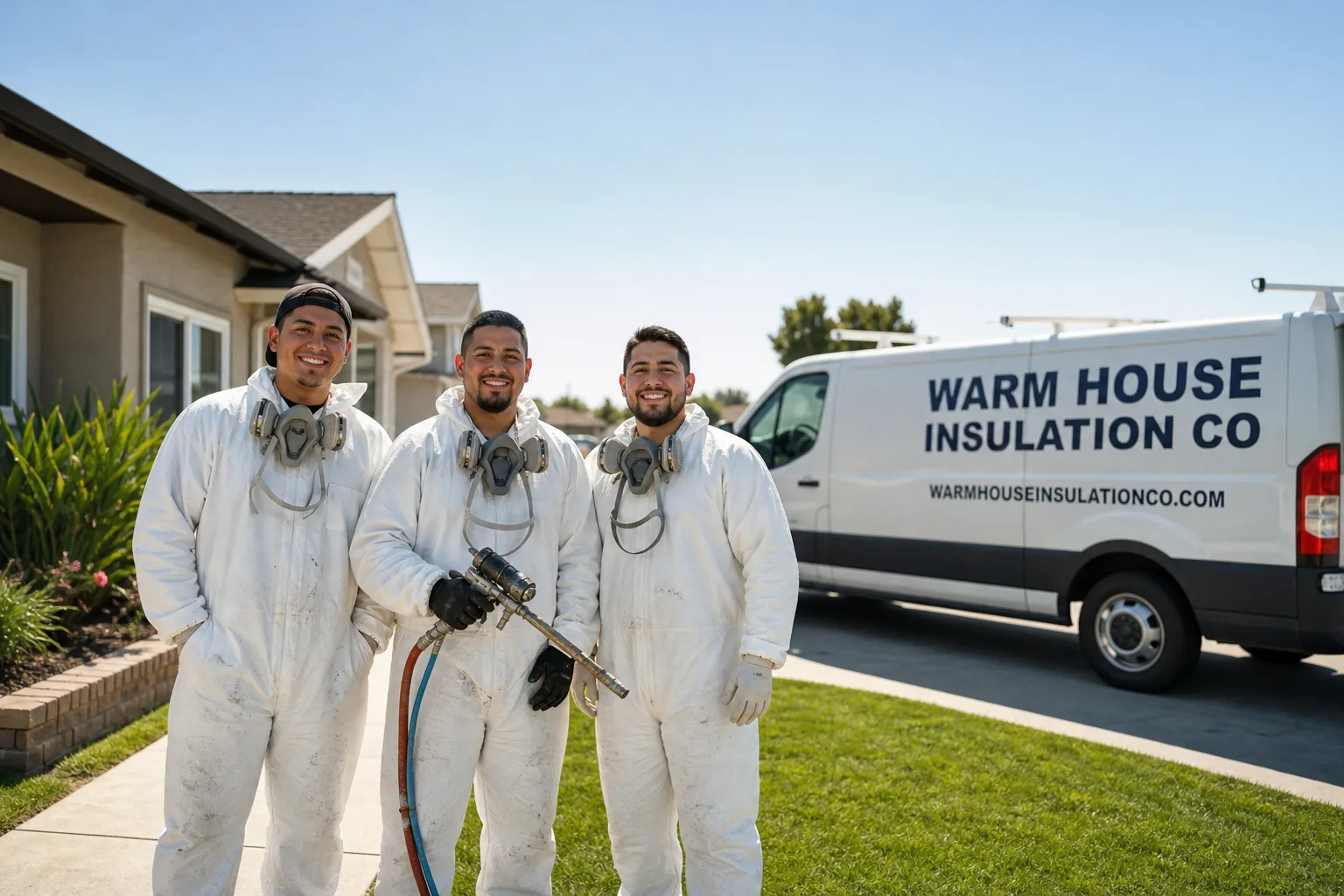
Spray Foam Insulation in Paramount, CA: Costs, Process, and Local Expertise
Spray foam insulation in Paramount typically runs $2.50 to $6.50 per board foot installed, with most whole-attic or wall-cavity projects landing between $2,800 and $9,500 depending on square footage, roof height, and whether you choose open-cell or closed-cell foam. In Paramount specifically, the work concentrates on slab-on-grade 1940s-1960s tract homes where attics are shallow, roofs are low-pitch or flat, and wall cavities have never been insulated. We’re in Paramount every week, and we know exactly what those rooflines do to insulation over time. If you’re tired of an upstairs that never cools or a garage that radiates heat into the house, call us at (866) 361-3775 for a straight read on your home.
Why Warm House Insulation Co Is Paramount’s Preferred Spray Foam Insulation Company
Paramount homeowners keep calling us back because we treat the diagnosis as the job, not the afterthought. Most of the spray foam work we do here begins with a question no one else asks: where is this house actually losing its cool? On a slab-on-grade stucco home on a 90723 block near Paramount Boulevard, the answer is almost always the roof deck and the 2×4 wall bays, not the floor. That changes how we spec foam, how we prep the attic, and what R-value we actually hit. Crews that blow through a flat-roof attic without removing dead fiberglass first are installing over a fire hazard and a thermal dead zone. We don’t do that.
Ruben Castellano sends the same crew leads to Paramount week after week, so the people in your attic know the difference between a 1948 tract roof on Garfield and a newer ADU over a backyard on Orange Avenue. That local memory matters. It means we arrive with the right gear, the right foam, and realistic expectations about attic access before we ever put a ladder up. Response to most Paramount jobs is same-day for estimates and within three to five business days for installation.
Garage Spray Foam Insulation in Paramount
Garage Spray Foam Insulation in Paramount fixes a problem most people don’t realize they have until August: the garage becomes a kiln, and that heat bleeds through the shared wall into the kitchen or bedroom. On low-pitch roofs and flat-roof garages that dominate the older pockets of Paramount, the ceiling gets scorching, and the door slab itself conducts enough afternoon heat to make the whole room unusable. We spray the ceiling deck and any shared wall cavities with open-cell Icynene or closed-cell Demilec depending on whether the garage needs moisture control, structural racking strength, or both.
What does it cost? A typical single-car garage in Paramount runs $1,400 to $2,800 for a full ceiling and shared-wall application. A detached two-car garage with higher square footage falls in the $2,600 to $4,500 range. The tightest variable is attic access. Many Paramount garages were never built with an access hatch, so the first step is often cutting one and flashing it properly. That’s not a short cut; it’s the only way to apply foam evenly across the entire ceiling plane. Call (866) 361-3775 and we’ll give you a number tied to your actual roof, not a brochure range.
Shared-Wall Sealing for Attached Garages
The wall between the garage and living space is the most cost-effective place to spray foam in a Paramount attached garage. A 2×4 stud cavity in a 1950s stucco home is only 3.5 inches deep, so closed-cell Demilec is almost always the right call. It seals air, adds racking strength to the wall plane, and hits the kind of R-value that fiberglass never will in that skinny cavity.
Detached Garage Roof Decks and ADU Conversions
If the garage is detached or you’re converting it into a rental or workshop, the roof deck becomes the main heat exchange surface. We spec open-cell Icynene for standard detached garages where budget matters and moisture isn’t a constant; we go closed-cell when the plan involves plumbing, a bathroom, or a conditioned space. Paramount’s ADU boom means we’re spraying detached garage conversions on a lot of the old 50-by-150 lots along side streets like Indiana and Madison.
Closed Cell Spray Foam Insulation in Paramount
Closed Cell Spray Foam Insulation in Paramount is the workhorse answer for the city’s flat and low-pitch roofs. At roughly 2 inches thick, closed-cell foam acts as an air barrier, a vapor retarder, and a structural stiffener for the roof deck, all in one pass. In a slab-on-grade home where under-floor insulation is impossible and wall cavities are too skinny to do much, the roof deck is the single biggest thermal boundary. We spray closed-cell Demilec directly to the underside of the roof sheathing, converting open attic space into a semi-conditioned buffer zone. That’s how you stop a 140-degree attic from radiating into the ceiling drywall below it all afternoon.
Cost for closed-cell in Paramount runs $3.75 to $6.50 per board foot, and a typical 1,100-square-foot low-pitch attic lands between $4,100 and $7,200. You’ll pay more on steeper older roofs with deep knee walls or on projects that require removing collapsed fiberglass and re-baffling the eaves first. The prep is non-negotiable here. Paramount’s hot inland summers bake old batts down to nothing, and spraying over them traps heat and hides bad venting. We pull the dead material and start clean. That’s a distinction you’ll notice the first summer after the job.
Title 24 Compliance and Venting Changes
Closed-cell foam on a roof deck changes the attic from a vented assembly to an unvented one, so Title 24 rules in Los Angeles County apply directly. On most Paramount homes built before 1970, we’re also correcting decades of passive venting that never worked well anyway. We document the assembly, install code-required ignition barriers where needed, and make sure the permit file reflects what we actually sprayed, not what the last contractor claimed.
Wind-Driven Rain and Edge Sealing
Paramount sits far enough inland that coastal fog isn’t a daily factor, but Santa Ana wind events push rain sideways under aging drip edges and gable ends. We’ve seen water wick down wall-injection ports and spoil open-cell adhesion in stucco cavities near the roofline. Closed-cell foam handles that water exposure far better than open-cell, especially along the eave line. For roof decks, it’s not even close.
Trusted Brands We Service in Paramount
We install both Icynene and Demilec spray foam systems, and we carry Rockwool mineral wool for the fire-rated wall assemblies and noise-sensitive projects that come up in Paramount’s older duplexes and converted garages. Carrying two major spray foam lines isn’t a gimmick; it means we pick the product based on your roof pitch, cavity depth, moisture exposure, and budget, not based on what’s in the back of the truck. For Paramount customers, that usually means open-cell Icynene on budget-driven garage ceilings and closed-cell Demilec on roof decks and stucco wall injections. Parts and material are staged out of our Stanton yard, which is about fifteen minutes from any Paramount zip code, so there’s no long lead time on reorders or warranty touch-ups.
Common Spray Foam Insulation Problems We See in Paramount Homes
- Cooked and compressed fiberglass in flat-roof attics. Decades of direct sun on low-pitch roofs bake fiberglass batts down to R-5 or less. Spraying foam over the top without pulling it first is a thermal and sometimes a fire-safety problem. We strip it before we spray.
- Low attic clearance that leads to rushed, uneven passes. A 3-foot attic at the ridge means a crew has to work flat on their backs. Some contractors speed through the roof-deck spray and leave thin spots that fail Title 24 inspection. We plan the access path first, then the foam layers.
- Moisture wicking under aging roof edges. Santa Ana winds drive rain sideways into stucco wall caps and old drip edges around the 90723 zip core. That moisture tracks into wall-injection ports and degrades foam adhesion. We inspect and seal the eaves before spraying closed-cell at the roofline.
- Uninsulated 2×4 wall cavities that nobody ever addressed. Most 1940s-1960s Paramount stucco homes have empty stud bays. The only practical fix without opening drywall is injection through the stucco from the outside. We do it with closed-cell foam and a moisture check first.
Pricing for Spray Foam Insulation in Paramount, CA
Here are the numbers, straight from our Paramount jobs over the last two years. Open-cell spray foam runs $2.50 to $4.00 per board foot installed; closed-cell runs $3.75 to $6.50. A full attic roof-deck spray on a 1,000 to 1,200 square-foot flat-roof home runs $3,800 to $7,200. A single attached garage ceiling on a shared wall falls between $1,400 and $2,800. Wall injections for a 1,000-square-foot stucco tract home run $2,200 to $4,800 depending on how many wall bays are open and whether we’re working from the exterior or through interior drywall. The biggest local cost driver is attic access clearance. Low rooflines with no access hatch add time and occasionally require cutting one. We quote that honestly up front. Estimates in Paramount are free. Call (866) 361-3775. We’ll give you a fixed number, not a range guess.
We Also Serve Cities Near Paramount
From our Stanton shop, we cover Bellflower and Downey to the north and east, Lynwood just across the 105, and Paramount itself seven days a week. On any given week our crews are also running insulation jobs in East Rancho Dominguez and the surrounding Southeast LA corridor. If you’re within fifteen minutes of the 710 or the 105, you’re in our regular service area. See our main Spray Foam Insulation page for the full overview of materials and methods.
Serving Paramount, CA — Our Local Coverage Area
We’re based in the Paramount area and know this community well. Use the map below to see our service coverage — if you’re nearby, we can almost certainly help.
FAQs About Spray Foam Insulation in Paramount
Because most Paramount homes sit on slab-on-grade foundations on the former Hynes-Clearwater flood plain. There is no crawlspace to work from. The house sits directly on concrete, so all the thermal losses happen through the roof deck and the 2×4 stucco wall cavities. Spray foam applied there does the same job under-floor batts would do in a city with raised foundations, and it does it where Paramount’s heat actually enters. Call (866) 361-3775 and we’ll explain what your specific roofline needs.
Yes, and it’s one of the underrated benefits of closed-cell foam. When we spray a low-pitch roof deck, the foam bonds the sheathing to the rafters, which stiffens the whole roof assembly against the kind of gusting we get during Santa Ana wind events. On wall injections, closed-cell foam adds racking strength to the stucco-bearing stud wall. It isn’t a retrofit wind brace, but it measurably tightens the structure. Our crews see the difference every time we open up an old Paramount attic that’s been flexing for sixty years.
We remove it. In low-pitch and flat-roof attics across Paramount, decades of heat compress fiberglass batts down to a fraction of their original R-value. If we sprayed foam directly over that dead material, the foam would seal the heat under the roof deck and give you a hot, stuffy attic that fails any honest R-value reading. Pulling the old batts is part of every spray foam estimate we write in this city. It’s the difference between a job that works and a job that just looks fine from the hatch.
Yes. Any new detached ADU or garage conversion in Paramount is a new conditioned space, and Los Angeles County enforces Title 24 energy requirements on the insulation assembly. That means hitting specified R-values for the roof deck and walls, installing the right ignition barriers over foam, and documenting the assembly for inspection. We’ve insulated enough Paramount ADUs over the last few years to know what the local inspectors look for, and we prep the permit file accordingly. Ruben Castellano’s crews handle the foam and the paperwork together. Call (866) 361-3775 if you’re planning an ADU and need a spec.
We plan for it before we start. Many Paramount homes don’t have a real access hatch, and the ones that do often sit under 3 feet of clearance at the ridge. Our crews work flat on their backs with respirators and drop cloths down to the ceiling joists, and we stage the foam passes from the farthest eave inward so we’re never spraying toward the exit. If there’s no hatch, we cut one and flash it properly. It’s slower than what you’d see on a tall ranch attic in Orange County, but it’s the only way to get an even, code-compliant foam layer on a Paramount flat roof.
The Paramount Specifics: Slab-on-Grade, Low Roofs, and the Attic Access Bottleneck
If you drive down Paramount Boulevard or cut through the side streets around Garfield and Orange, you’ll see the same house repeated hundreds of times: a single-story stucco tract home from the late 1940s or 1950s, slab-on-grade, with a roof that barely rises above the wall plate. That building type drives almost every decision we make about spray foam in this city. There is no crawlspace, so under-floor work is irrelevant. The walls are 2×4 stucco-bearing construction with empty stud bays, which limits what cavity-depth insulation can achieve. The attic is shallow, often under 4 feet at the peak, and the roof deck is the one surface where we can meaningfully change the thermal and structural behavior of the whole house. On a 1950s slab-on-grade stucco tract home near the 90723 ZIP core, our crew found decades-old fiberglass batts cooked flat under a low-pitch roof and 2×4 wall cavities with no insulation at all. Because there was no crawlspace to work from, we injected closed-cell Demelec foam into the stucco wall bays and sprayed the roof deck above, sealing the attic and cutting the afternoon heat gain before the next Santa Ana wind event.
That same roof height is the real bottleneck on every Paramount job. You can’t move fast in a 3-foot attic. You can’t stand, you can’t stage material easily, and you can’t hide thin passes. The companies that rush this work end up leaving gaps the inspector doesn’t catch, and the homeowner doesn’t find out until July. We’d rather lose a day on access than deliver a foam layer with the R-value of a car sunshade.
Get a Straight Answer About Your Paramount Home
If you live in Paramount and your attic roasts, your garage heats up the kitchen, or your walls feel like drywall over a campfire in August, call us. Ruben Castellano and the Warm House Insulation Co crew will give you an honest diagnosis of what’s happening above the ceiling and inside the walls, what it costs to fix, and what product matches your specific roofline and cavity depth. We don’t do one-size-fits-all, and we don’t spray over problems. Call (866) 361-3775 for a free estimate. We’re in Paramount every week, and we’ll tell you straight what your house needs.
Written by Ruben Castellano, Owner at Warm House Insulation Co, serving Paramount since our first slab-on-grade roof-deck job in the city.