
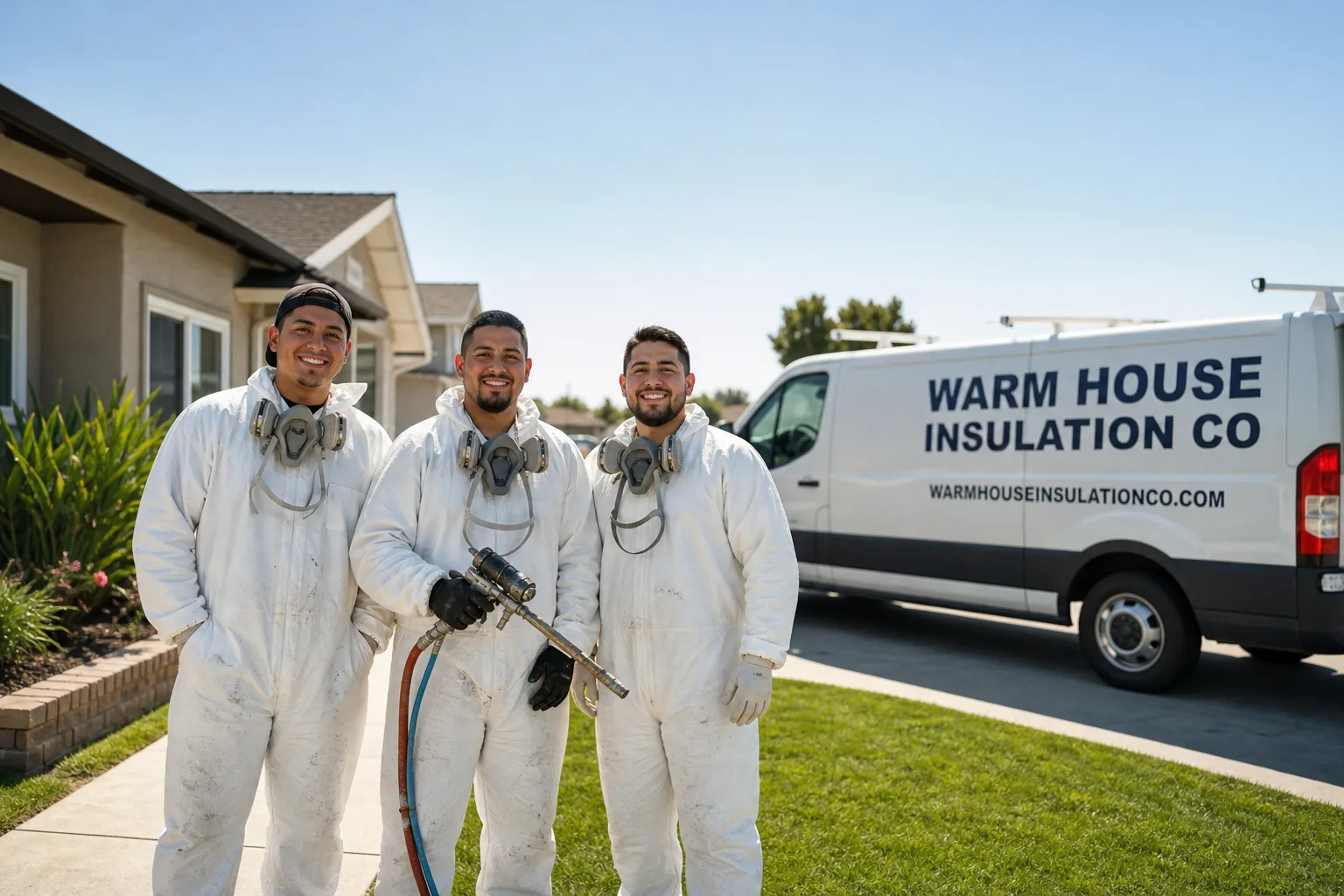
Fast, Reliable Spray Foam Insulation Across Portola Hills
Spray foam insulation for a typical Portola Hills home runs $2,800 to $7,200 depending on the area treated, with rim joist work usually landing between $1,600 and $2,400. Most jobs we book here are done within three to five business days of the estimate. If you live off Portola Parkway, near Saddleback Ranch Road, or up in the Ridgeline community, you’re dealing with canyon winds and a marine layer that most insulation contractors don’t account for. We do. Call (866) 361-3775 and we’ll walk your home, check what’s actually failing, and give you a straight answer on what needs sealing and what doesn’t.
Portola Hills sits in a high fire severity zone, which means the spray foam we install here often has to work within ignition-resistant assembly requirements under California Building Code Chapter 7A. That’s not a generic insulation conversation. It’s a Portola Hills conversation, and we have it every week with homeowners in this zip code.
Why Warm House Insulation Co Is Portola Hills’s Preferred Spray Foam Insulation Company
We’re led by Ruben Castellano, and we’re based just down the road in Stanton, so a Portola Hills service call doesn’t sit in a dispatch queue for days. Ruben built this company around a simple frustration: most insulation contractors stock one or two products and then talk homeowners into whatever they happen to have on the truck. That doesn’t work in Portola Hills, where the marine layer pushes through Santiago Canyon most evenings and the afternoon winds do things to insulation that flatland communities never see.
Our Portola Hills customers routinely mention two things: we show up when we say we will, and we don’t push a single brand. We carry both Icynene and Demilec spray foam systems, which matters because open-cell and closed-cell foams solve different problems. A rim joist in a 1988 tract home off Glenn Ranch Road needs a different specification than an attic roof deck in the Ridgeline. Homeowners here have told us they’d already talked to two or three contractors who never asked about Chapter 7A compliance. That’s the first thing we check.
Rim Joist Spray Foam in Portola Hills
Rim joist spray foam in Portola Hills is the single most overlooked fix we do, and in this canyon climate it’s the one that delivers the fastest comfort change. The rim joist is the band of wood where your floor framing meets the foundation wall. In most 1980s and 1990s homes here it was never sealed at all. That leaves a direct path for canyon-driven air to push into the house, and for the marine layer to ride that same air into your floor cavities every evening. We foam the entire rim joist band with closed-cell spray foam, which air-seals and insulates in one pass. A typical Portola Hills rim joist job runs $1,600 to $2,400 depending on linear footage and access. Most are done in a single day.
When It’s Time to Seal the Rim
You’ll know the rim joist is failing when floors near exterior walls feel cold in winter, when you smell a musty note after the marine layer rolls in, or when you see ant activity along the baseboards. Ants follow moisture, and moisture follows unsealed rim joists. We see this pattern constantly in the older sections of Portola Hills, especially in homes where original fiberglass batts have settled away from the band board.
Icynene vs. Demilec at the Rim
For most Portola Hills rim joists we specify a closed-cell foam, usually Demilec, because it acts as a vapor barrier and adds structural rigidity. Icynene open-cell is the better call when the rim area is irregular or has existing electrical runs that make a rigid closed-cell application impractical. We stock both on the truck, so the decision is driven by what your rim actually looks like, not what we happened to load that morning.
Crawl Space Spray Foam Insulation in Portola Hills
Crawl space spray foam insulation in Portola Hills solves a problem that most homeowners here don’t realize they have until the floors feel damp in summer and cold in winter. Many of these 1980s Mediterranean-style homes sit over vented crawl spaces that were never sealed against the diurnal temperature swings this canyon creates. When warm daytime air hits the cool crawl space after the marine layer arrives, condensation forms on joists and subflooring. We apply spray foam directly to the crawl space walls and rim area, converting a vented, moisture-prone space into a conditioned buffer zone. A full crawl space encapsulation with spray foam in Portola Hills typically runs $3,400 to $6,800 depending on square footage and access clearance.
Moisture and the Marine Layer
The marine layer that pushes through Santiago Canyon every evening is not a subtle influence. It carries enough moisture to condense on unsealed crawl space surfaces night after night. That’s how you get the persistent damp smell that creeps up through the floor. Closed-cell foam on the crawl space walls stops that condensation cycle at the source.
Canyon Wind Intrusion
The same afternoon winds that dislodge attic batts also drive air through crawl space vents and unsealed rim areas. Sealing the crawl space with spray foam stops that air movement entirely. Portola Hills homeowners who’ve had this done tell us their floors feel noticeably warmer in January, and the musty smell disappears within a day or two.
Trusted Brands We Service in Portola Hills
We install and service both Icynene and Demilec spray foam systems, and we carry Rockwool mineral wool for Portola Hills homes where fire-rated assembly requirements make mineral wool the better specification. Because we’re authorized across these product lines, we don’t have to work around a single brand’s limitations. We also keep common replacement materials and touch-up kits stocked for Portola Hills service calls, which means we’re not running back to the supply house mid-job. For a Chapter 7A retrofit, the brand matters less than the assembly spec, and we know how to match the two. That’s exactly the kind of detail that gets missed by insulation crews who don’t work in fire severity zones.
Common Spray Foam Insulation Problems We See in Portola Hills Homes
- Canyon wind batt displacement. The afternoon winds funnel through Portola Hills and dislodge attic batts near roof vents and ridge lines. Homeowners feel a hot spot upstairs and call an HVAC company. It’s almost never the HVAC. It’s the insulation that’s no longer where it was installed.
- Settled R-13 wall insulation. Original 1980s R-13 batts in stucco-frame walls settle, tear, and leave unsealed gaps. Those gaps let marine-layer moisture into the wall cavity, and from there into the living space. Spray foam fills and air-seals those voids permanently.
- Unsealed rim joists on older tract homes. The 1988 through 1995 builds around Portola Parkway and Saddleback Ranch Road almost universally have unsealed rim joists. That’s a direct air and moisture path into the home’s envelope. We see it on nearly every first visit.
- Radiant barrier degradation in attics. Many Portola Hills attics have original foil radiant barriers that have torn or oxidized. Once the barrier fails, attic temperatures spike and the HVAC runs constantly. Spray foam at the roof deck eliminates the need for a separate radiant barrier altogether.
Pricing for Spray Foam Insulation in Portola Hills, CA
Here’s what Portola Hills homeowners should expect to pay. Rim joist spray foam runs $1,600 to $2,400. Crawl space encapsulation with spray foam runs $3,400 to $6,800. A full attic roof deck application, which is the most common whole-attic treatment in Portola Hills, runs $4,200 to $7,200 for a typical 1,400 to 2,200 square foot home. Closed-cell foam runs higher per board foot than open-cell, but it’s often the right call for WUI compliance and vapor control in this canyon climate. The condition of the existing insulation, access clearance, and whether Chapter 7A ignition-resistant detailing is required all move the number. We give free estimates and the quote we give is the price you pay. For an exact number on your Portola Hills home, call (866) 361-3775.
We Also Serve Cities Near Portola Hills
If you’re outside Portola Hills but nearby, we make regular runs to Foothill Ranch, Lake Forest, Mission Viejo, and Trabuco Canyon. Our Spray Foam Insulation team works the entire 92610 corridor and beyond. And if you’re reading this from a neighboring canyon community, you can also see what we do in Portola Hills to understand how we handle WUI compliance and marine-layer moisture. Call (866) 361-3775 and we’ll tell you straight whether we can get to your street this week.
Serving Portola Hills, CA — Our Local Coverage Area
We’re based in the Portola Hills area and know this community well. Use the map below to see our service coverage — if you’re nearby, we can almost certainly help.
FAQs About Spray Foam Insulation in Portola Hills
Yes, when spray foam is installed in the attic roof deck or exterior wall assemblies of a Portola Hills home, it typically has to sit behind an ignition-resistant barrier that meets California Building Code Chapter 7A requirements for Wildland-Urban Interface zones. That usually means the foam is covered by a thermal or ignition barrier like drywall, mineral wool, or an approved intumescent coating. We verify Chapter 7A compliance on every Portola Hills project before we spray. Call (866) 361-3775 and we’ll check what your specific assembly requires.
That whistle is canyon wind being driven through your attic vents, and the energy spike usually means the insulation near those vents has been dislodged. We recently foamed the rim joists of a 1988 Mediterranean tract home near Portola Parkway and Saddleback Ranch Road where displaced attic batts had created a hot spot the homeowner was sure was an HVAC failure. After we sealed with Icynene spray foam and verified WUI compliance, the attic temperature dropped 12 degrees and the system stopped cycling constantly. Call (866) 361-3775 and we’ll see if the same thing is happening in your attic.
Yes, closed-cell spray foam is the most effective moisture control we install in Portola Hills, because it creates a continuous air and vapor barrier at the rim joist, crawl space walls, or roof deck. The marine layer pushes through Santiago Canyon most evenings, and it condenses on any cool, unsealed surface it reaches. Eliminating those cold surfaces is the fix. For moisture problems specifically, we usually specify Demilec closed-cell foam. Call (866) 361-3775 for an assessment.
In almost every Portola Hills home built in the 1980s, yes. The original R-13 batts in stucco-frame walls have settled, torn, and left gaps that no longer insulate or seal. Spray foam injected into those cavities, or applied at the rim and attic, restores the thermal boundary and the air barrier together. What you’re fixing is not just the R-value, but the air movement through the wall, which is the bigger comfort problem. Call (866) 361-3775 and we’ll tell you what your walls actually need.
Portola Hills sits inside a Wildland-Urban Interface fire severity zone, which means our spray foam applications routinely have to satisfy Chapter 7A ignition-resistant assembly requirements that don’t apply in Lake Forest or Mission Viejo. The canyon winds and marine layer also create a dual demand: the foam has to resist heat gain during hot afternoons and manage moisture every single night. Most insulation contractors in flatland cities never deal with either condition. We deal with both on every Portola Hills job.
Written by Ruben Castellano, Owner at Warm House Insulation Co, serving Portola Hills since day one.