
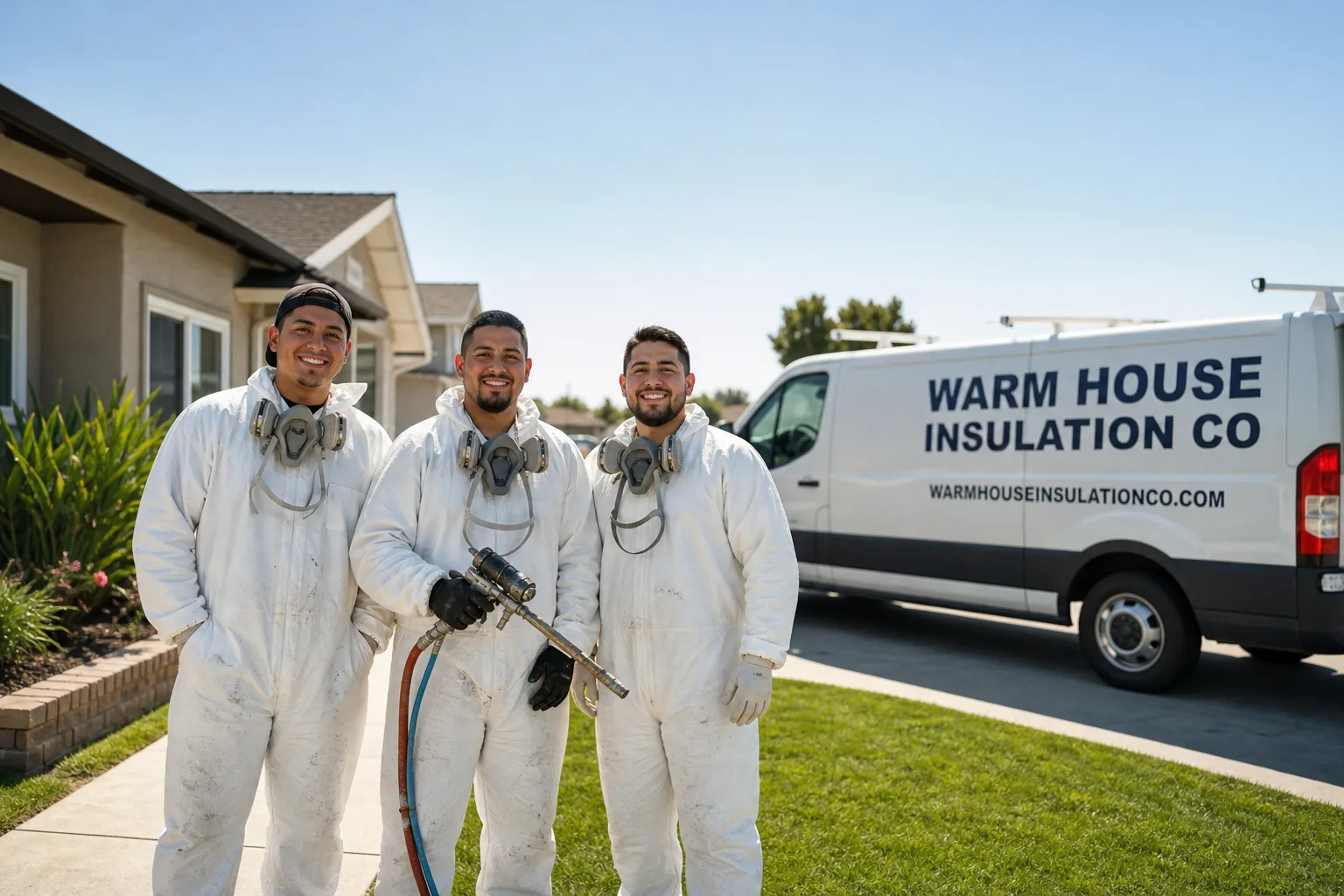
Fast, Reliable Spray Foam Insulation Across Santa Ana
Spray foam insulation in Santa Ana homes typically costs between $2,800 and $7,500 for an attic or garage project, and most jobs are completed in one to two days. That’s the direct answer. The longer answer involves your house: if it was built before 1978, and most of Santa Ana’s housing stock was, the job is as much about air sealing and wiring as it is about foam. We’ve spent years working in the older attics and crawlspaces that define this city, from the bungalows off French Street to the stucco tracts near the 55. Call (866) 361-3775 and we’ll tell you what your specific house needs, not what we happen to have on the truck.
Why Warm House Insulation Co Is Santa Ana’s Preferred Spray Foam Insulation Company
Ruben Castellano started Warm House Insulation Co with a simple frustration: most insulation contractors push one product because that’s what they stock. We carry eight brands across every major category, including both Icynene and Demilec spray foam systems, so the recommendation you get is based on your home’s needs, not our inventory. Ruben built the company around diagnosis first, product second, and that’s the approach we bring to every Santa Ana job.
Santa Ana homeowners call us because we know what’s actually inside these houses. We’ve worked in attics with live knob-and-tube wiring, we’ve seen what decades of Santa Ana winds do to blown-in insulation, and we know which foam system makes sense for a shallow 1940s attic versus a 1960s tract home. Our crews respond to Santa Ana within 90 minutes for estimates, and we schedule most spray foam work within the week. When you call, you’re talking to someone who can tell you what a closed-cell foam roof deck application should cost in your neighborhood, not a call center reading a script.
We work across Santa Ana from the downtown lofts to the edges of the city, and we’re authorized to install products most local contractors don’t carry. That matters when you need something specific: a Rockwool fire-rated barrier for a garage conversion, an Icynene open-cell application for sound dampening, or a Demilec closed-cell system for a moisture-prone attic. The right material exists. We can actually install it.
Garage Spray Foam Insulation in Santa Ana
Garage Spray Foam Insulation in Santa Ana usually means converting a space that was never designed for comfort into one that is. Most garages here, especially in the pre-1960s bungalows and stucco tract homes, were built with zero insulation in the walls or ceiling. In summer, they turn into ovens. In winter, they’the coldest room in the house. Spraying foam changes that because it air seals and insulates in one pass, filling the gaps around old framing and stopping the hot air that pushes through every crack during a Santa Ana wind event.
Ceiling and Roof Deck Applications
For garages with an attic space above, we often spray the ceiling deck from below or the roof deck from above. Closed-cell foam works well here because it adds structural rigidity to older framing and stops moisture migration in Santa Ana’s dry-but-dewy mornings. The material adheres directly to the wood, so you don’t need to remove old fiberglass batts first, though we do recommend removing anything compacted or rodent-damaged.
When a Santa Ana Garage Needs It
You’ll notice it when you walk in on an August afternoon and the air feels like a convection oven. Or when you’re working in the garage in January and your hands go numb. Spray foam in a typical two-car Santa Ana garage runs $2,000 to $4,500 depending on wall height, existing insulation, and whether you want the walls, ceiling, or both done. The foam pays for itself over time if you spend any hours in that space or if your garage sits under a bedroom.
Closed Cell Spray Foam Insulation in Santa Ana
Closed Cell Spray Foam Insulation in Santa Ana is the workhorse for older homes where attic depth is limited and air leakage is the real enemy. Because closed-cell foam is dense – roughly R-6.5 to R-7 per inch – it delivers more insulation value in less space than open-cell or fiberglass. That matters in Santa Ana’s shallow attics, where a 1940s bungalow may only have 6 or 8 inches of rafter depth to work with.
Moisture and Air Barrier in One
Closed-cell foam acts as both an air barrier and a vapor retarder at just 2 inches of thickness. For Santa Ana homes near the Santa Ana River or in the flatter, older neighborhoods like the ones bisected by Bristol and Main, that matters. The marine layer pushes damp air inland on summer mornings, and closed-cell foam stops that moisture from condensing inside your attic assembly. Fiberglass can’t do that. Open-cell foam can’t do it as effectively.
Rim Joist and Band Board Sealing
One of the highest-value closed-cell applications we do in Santa Ana is rim joist sealing. The band board – the wood perimeter where your floor meets your foundation – is a massive air leak in most older homes. Spraying just the rim joist in a typical Santa Ana house costs $1,200 to $2,800 and often cuts drafts and dust infiltration dramatically. It’s the unsung hero of older home comfort.
Why Pre-1978 Housing Stock Changes the Job
Santa Ana’s pre-1978 housing stock means spray foam jobs regularly run into knob-and-tube wiring and ungrounded circuits hidden in shallow attic assemblies, requiring careful isolation or rewiring before foam can be applied. This is the thing no generic insulation page tells you, and it’s the thing that separates a professional spray foam job from a dangerous one. You cannot simply spray foam over live knob-and-tube wiring. The foam traps heat against the conductors, which can degrade the cloth insulation and create a fire risk. In a shallow Santa Ana attic where clearance is already tight, the risk compounds.
On a 1940s stucco bungalow off French Street, our crew found the garage attic packed with compacted blown-in insulation and live knob-and-tube wiring feeding old ceiling fixtures. We air-sealed the top plates, rerouted the wiring through conduit, and applied closed-cell spray foam to the roof deck and gable walls, stopping the dust infiltration that had been fouling the old insulation for years. That’s the reality of working in Santa Ana: the foam is the final step, not the first one. The first step is understanding what’s underneath.
Mid-century stucco tract homes, common in the areas around Santiago Street and the 92701 and 92702 zip codes, often have their own issue: unvented or poorly vented attic assemblies. If you spray closed-cell foam against an unvented roof deck without addressing the ventilation question, you can trap moisture inside and rot the deck sheathing from the inside. We check venting before we specify foam, and we’ll tell you honestly if your attic needs soffit or ridge ventilation added first.
Then there’s the wind. The dry, gusty Santa Ana winds that give this city its name push fine dust and hot air through every gap in aging attic assemblies. Technicians here routinely find blown-in insulation that’s been compacted or fouled by decades of dust infiltration, which crushes its R-value. If you spray foam directly over that compacted layer without removing it or air sealing first, you can lock in the problem and trap moisture against the old insulation. In Santa Ana specifically, air sealing is the real first step before topping off with foam.
Trusted Brands We Service in Santa Ana
We install both Icynene and Demilec spray foam systems, which gives Santa Ana homeowners a genuine choice between open-cell and closed-cell foam from two of the most specified brands in North America, plus Reflectix repair in Santa Ana when radiant barriers are the right solution. Most contractors stock one. We carry both, along with Rockwool mineral wool and CertainTeed and Knauf fiberglass for hybrid projects where spray foam alone isn’t the right answer. Because we’re authorized across eight manufacturers, we’re not trying to sell you whatever happens to be in our warehouse. We’ll spec Icynene open-cell for a sound-dampening interior wall, Demilec closed-cell for a moisture-prone rim joist, and Rockwool when you need a fire-rated barrier for a garage or mechanical room. Local Santa Ana supply relationships mean we can get material fast when a job needs a specific product.
How Title 24 Affects Spray Foam Insulation in Santa Ana
California’s Title 24 energy code applies to any insulation project in Santa Ana, and it’s more stringent here than in most of the country. For attics in climate zone 8, which covers Santa Ana and inland Orange County, the current requirement is effectively R-38 for attic insulation in new construction and major remodels. Spray foam meets those requirements in less depth than fiberglass or cellulose because of its higher R-value per inch. If you’re doing a permitted remodel in Santa Ana, your insulation plan needs to demonstrate compliance, and closed-cell foam at rafter level can satisfy both the insulation and air sealing requirements in one application. For older homes where a full Title 24 upgrade isn’t required, we still recommend getting as close to modern levels as your attic framing allows. The gap between a 1960s tract house with R-11 batts and a sealed, foamed attic is enormous in terms of comfort and energy use.
Common Spray Foam Insulation Problems We See in Santa Ana Homes
- Foam applied over knob-and-tube wiring. We’ve seen it in attics across the older neighborhoods near downtown Santa Ana. The foam traps heat, the cloth wiring degrades, and you have a fire waiting to happen. In shallow attics where clearance is tight, the risk is even worse. The fix is rerouting the wiring through conduit before spraying.
- Dust-compacted blown-in insulation under new foam. Years of Santa Ana wind events push fine dust into older attic assemblies until the original insulation is dense, dirty, and almost useless. Spraying foam over that without removing it first locks in the problem. We remove and dispose of the compacted material, air seal, then spray.
- Unvented attics with closed-cell foam and no ventilation. Mid-century stucco tract homes often have sealed-up eaves and no ridge vent. Spray closed-cell foam against that roof deck and you’ve created a moisture trap that can rot the sheathing. We inspect venting before we specify closed-cell on a roof deck.
- Gaps around old ductwork and ceiling penetrations. In Santa Ana’s hottest months, the temperature in an unsealed attic can exceed 140 degrees. Every gap around a light fixture or duct boot is a conduit for that heat to pour into your living space. Foam applied without first sealing those penetrations is like caulking a boat hull while leaving the drain plugs out.
Pricing for Spray Foam Insulation in Santa Ana, CA
Here’s what we actually see when we quote spray foam work across Santa Ana’s 92701, 92702, and 92735 zip codes. Garage ceiling spray foam typically runs $1,800 to $3,900. Garage walls add another $2,200 to $4,800 depending on height and framing. A full attic roof deck application in a smaller 1940s-1960s home runs $3,200 to $6,000. Rim joist sealing runs $1,200 to $2,800. Both Icynene and Demilec systems fall within these ranges, with closed-cell running about 30-40% more per board foot than open-cell. The variables are square footage, depth of application, whether we need to remove old insulation first, and whether legacy wiring needs to be rerouted before we spray. Call (866) 361-3775 for an exact quote. Estimates are free, and we’ll walk you through the numbers in plain English.
For the full scope of what spray foam can do in older Orange County homes, see our Spray Foam Insulation service page.
We Also Serve Cities Near Santa Ana
Warm House Insulation Co serves all of Orange County, including Tustin, North Tustin, Fountain Valley, and Orange. If you’re in one of those cities and need the same expertise we bring to Santa Ana, call us at (866) 361-3775. We’re based in Stanton, which puts us within 20 minutes of almost every neighborhood in central Orange County, so response times are fast regardless of which city you’re in. Learn more about what we do across the region on our Spray Foam Insulation in Santa Ana page.
Serving Santa Ana, CA — Our Local Coverage Area
We’re based in the Santa Ana area and know this community well. Use the map below to see our service coverage — if you’re nearby, we can almost certainly help.
FAQs About Spray Foam Insulation in Santa Ana
No, and we won’t do it. Spray foam applied directly over live knob-and-tube wiring traps heat against the conductors, which degrades the cloth insulation and creates a fire risk. In Santa Ana attics, where shallow framing often leaves little clearance, the risk is worse. The wiring needs to be rerouted through conduit or otherwise isolated before foam is applied. We handle this as part of the job when it comes up, and we’ll tell you before we quote if it’s likely in your house.
Spray foam helps with Santa Ana winds and dust because it’s the only insulation that air seals as it insulates. The foam expands into every crack, gap, and penetration around old framing, ductwork, and wiring, which is exactly where the dry, gusty winds push fine dust and hot air through aging attic assemblies. Once those gaps are sealed, the dust stops getting in. Blown-in and batt insulation can’t do that because they don’t stop air movement. If dust has been settling on your belongings every time the winds pick up, that’s a sign your house needs air sealing, and spray foam is the most effective way to do it. Call (866) 361-3775 to talk through your situation.
For a Santa Ana garage, open-cell foam is the better choice if you want sound dampening and a lower price point, while closed-cell is better if you want maximum R-value, moisture resistance, and structural rigidity. Open-cell foam is less dense, expands more, and does a great job of reducing noise transfer – useful if your garage sits under a bedroom or next to a neighbor. Closed-cell is denser, costs more per board foot, but acts as a moisture barrier and adds shear strength to the wall. In an unconditioned Santa Ana garage that sees summer heat and winter dampness, closed-cell usually wins for the ceiling and rim joist areas, while open-cell works well for walls where sound is the primary concern. We’ll walk you through the tradeoffs before you decide.
Title 24 requires attics in Santa Ana’s climate zone to meet R-38 standards for new construction and major remodels, and spray foam meets that requirement in less depth than other insulation types because of its higher R-value per inch. If you’re pulling a permit for a remodel in the 92701, 92702, or 92735 zip codes, your insulation plan will be reviewed for compliance. For older homes where you’re not doing permitted work, Title 24 doesn’t force an upgrade, but it sets a useful benchmark: most pre-1978 Santa Ana attics are dramatically under-insulated relative to what the state now requires, and closing that gap is the single biggest thing you can do for summer comfort. We can tell you exactly where your house stands relative to current code.
Sometimes yes. If the old insulation is compacted from years of dust infiltration, water-damaged, or rodent-fouled, it needs to come out before we spray. Compaction crushes R-value, and spraying foam over it locks the problem in place. In Santa Ana specifically, the dry, gusty winds mean compacted insulation is more common here than in coastal cities. If the old material is still loose and dry, it can sometimes be left in place and topped with foam, but we’ll assess that on site. Removal and disposal typically adds $500 to $1,500 to a job depending on attic size and access, and it’s worth every dollar when the alternative is trapping degraded insulation under new foam.
Written by Ruben Castellano, Owner at Warm House Insulation Co, serving Santa Ana and Orange County with spray foam, attic, and blown-in insulation since our founding.