Last updated October 31, 2026
The Complete Guide to Insulation in Stanton
Most insulation guides you’ll find online were written for houses in Minneapolis or Chicago, where the furnace runs six months a year and the goal is trapping every possible BTU indoors. Stanton doesn’t have that problem. This city sits at the inland edge of Orange County, where summer afternoons routinely push into the 90s and cooling costs dwarf heating costs by a wide margin. If you insulate a Stanton home using advice meant for a Minnesota winter, you’ll spend money on the wrong materials in the wrong places. This guide explains what actually works here: which R-values matter in Climate Zone 8, where Stanton’s older homes lose the most energy, and why the right material for your attic may be entirely wrong for your walls.
Quick Answer
Insulation in Stanton should prioritize keeping heat out of the home rather than trapping it inside. Most Stanton homes benefit most from attic insulation upgraded to R-38 or higher, given that attics absorb the brunt of Southern California sun. The most cost-effective first step for the majority of local homeowners is air-sealing the attic floor combined with blown-in insulation, because cooling load, not heating load, drives energy bills in Climate Zone 8.
Table of Contents
- What Stanton’s Climate Actually Demands From Insulation
- R-Values in Climate Zone 8: What the National Guides Get Wrong
- Stanton’s Housing Stock and Its Predictable Insulation Gaps
- Why Attic Insulation Delivers the Fastest Payback in Stanton
- Radiant Heat and Why It Belongs in the Stanton Conversation
- Matching Materials to Zones: Attic vs. Walls vs. Crawlspace
- The Three Installation Methods, Explained Clearly
- Common Mistakes to Avoid
- When to Call a Professional
- Frequently Asked Questions
What Stanton’s Climate Actually Demands From Insulation
Stanton sits in a meteorological sweet spot that most national insulation guidance treats as an afterthought. We’re far enough inland that summer temperatures regularly reach the mid-90s, but close enough to the coast that nights cool down into the 60s. That diurnal swing, the gap between daytime highs and nighttime lows, changes what insulation needs to do.
In a cold climate, insulation’s primary job is holding heat inside for months at a time. In Stanton, the job is different. Your home absorbs solar energy all day through the roof, exterior walls, and windows. That heat works its way inward. When the air conditioner turns on, it fights a battle on two fronts: removing the heat that’s already inside and rejecting the heat that keeps trying to get in. Good insulation reduces the second load, which means the AC cycles less often, runs for shorter periods, and keeps indoor temperatures more stable.
But here’s the part few guides address: because Stanton cools down at night, insulation also regulates how quickly your home releases that stored heat. Homes with poor attic insulation often feel comfortable at midnight and miserable by 2 p.m. Homes with proper insulation and air sealing hold their overnight coolness longer, delaying the point where the AC kicks on each morning. That daily delay compounds over a summer. It’s the difference between an AC that runs eight hours a day and one that runs four.
Moisture is a secondary but real concern. Stanton’s winters, while mild, bring occasional rain and periods of marine layer influence. Insulation that absorbs moisture, like certain fiberglass products installed incorrectly, loses R-value and invites mold into the building envelope. That’s one reason material choice matters as much as insulation thickness in this climate.
For a deeper look at the most impactful insulation project in our climate, see our guide to Attic Insulation in Stanton.
R-Values in Climate Zone 8: What the National Guides Get Wrong
California’s Title 24 energy code places Stanton in Climate Zone 8. That designation specifies minimum R-values for new construction and major remodels. But minimums are not recommendations, and for older homes they’re nearly irrelevant. What matters is understanding which zones of your home do the most thermal work in a cooling-dominated climate.
The California Energy Commission recommends R-30 to R-38 for attics in Climate Zone 8. Here’s what that means in practice for a Stanton homeowner:
- R-19 in the attic: The standard found in many 1960s and 1970s homes. Effectively obsolete for this climate. The attic can reach 140 degrees in August, and R-19 offers minimal resistance to that load.
- R-30 in the attic: A meaningful improvement. Noticeable difference in upstairs comfort and AC runtime.
- R-38 to R-49 in the attic: The sweet spot for Stanton. Most homeowners recover the incremental cost within two to three cooling seasons through reduced energy use.
- R-13 to R-15 in walls: Acceptable for 2×4 framing, though most Stanton homes with original wall insulation fall below this due to settling and gaps.
The national guides that recommend R-60 attic insulation are tuning their advice for Minneapolis or Buffalo. In Stanton, the law of diminishing returns sets in earlier. Each additional inch of insulation past R-49 saves progressively less energy, because the temperature differential between the attic and living space, while significant, doesn’t justify the extreme depth required in northern climates.
What the national guides also miss is air leakage. R-value measures resistance to conductive heat transfer. It says nothing about convective heat movement through gaps, cracks, and bypasses. A Stanton attic with R-38 insulation and significant air leaks will perform worse than an R-30 attic that’s properly air-sealed. In our experience, sealing the attic floor before adding insulation is the single highest-value step for older Stanton homes.
Stanton’s Housing Stock and Its Predictable Insulation Gaps
Stanton grew substantially during the post-war housing boom, and much of the city’s single-family housing stock dates from the 1950s through the 1980s. These homes share predictable insulation shortcomings that newer-construction guides don’t address.
Most homes built in Stanton before the early 1980s received minimal insulation at the time of construction. Common findings in our work include:
- Attic insulation compressed to a fraction of its original depth. Fiberglass batts and blown-in fiberglass settle over decades, especially after roof leaks or HVAC work.
- Wall cavities with no insulation at all. Many mid-century Stanton homes have empty wall cavities. The builder relied on the region’s mild winters and saw no need for thermal protection.
- No air sealing between the attic and living space. Recessed lights, plumbing penetrations, and interior wall top plates create direct pathways for conditioned air to escape.
- Single-pane windows and uninsulated ductwork. While not insulation itself, these compound the effect of poor thermal barriers and increase the load on whatever insulation does exist.
- Missing or damaged crawlspace insulation. Homes with raised foundations often had fiberglass batts installed under the floor, and many have fallen or been torn out during plumbing repairs.
These patterns mean a Stanton homeowner shouldn’t assume their home meets any modern standard. Visual inspection, particularly of the attic, usually reveals the full picture within minutes. The gap between what was installed in 1972 and what the home actually needs today is often substantial.
Why Attic Insulation Delivers the Fastest Payback in Stanton
If you make one insulation improvement to a Stanton home, make it the attic. The physics are straightforward: the attic is the hottest part of the house in summer, and heat moves from hot to cold. In August, your attic can sit at 130 to 150 degrees while your living space is trying to hold 75. That’s a temperature differential of 55 to 75 degrees, far larger than the differential between a winter night and a heated interior. Insulation’s effectiveness scales with that differential. The bigger the gap, the more insulation does.
Southern California Edison’s tiered rate structure compounds the payoff. Stanton homeowners pay significantly more per kilowatt-hour during peak afternoon and evening hours, exactly when air conditioners work hardest against attic heat gain. Reducing that load shifts energy consumption to lower-cost periods and cuts total usage. The result is an outsized reduction on the bill relative to the actual energy saved.
For homes with existing but degraded attic insulation, the upgrade path usually looks like this:
- Inspection: Assess current insulation type, depth, and condition. Identify air leakage points.
- Air sealing: Seal penetrations around recessed lighting (if rated for contact), plumbing vents, electrical boxes, and wall top plates.
- Insulation installation: Bring the attic to R-38 or higher using blown-in material suited to the home’s circumstances.
- Verification: Confirm even coverage, especially in corners and over eaves, where installers sometimes leave thin spots.
We’ve written a detailed breakdown specific to Stanton homes. See Blown In Insulation in Stanton for material options and what to expect during installation.
Radiant Heat and Why It Belongs in the Stanton Conversation
Traditional insulation resists conductive and convective heat transfer. It does comparatively little against radiant heat, the direct transfer of energy from the sun to your roof deck, which then radiates downward into the attic and living space. In Stanton, where sunny days are the norm and summer sun angles are aggressive, radiant heat accounts for a meaningful portion of total cooling load.
This is why radiant barriers and reflective surfaces deserve more attention in Southern California than in most parts of the country. A radiant barrier stapled to the underside of roof rafters reflects a significant percentage of radiant heat back toward the roof deck before it can enter the attic space. In a vented attic, that reflected heat exits through ridge and soffit vents. The interior of the attic can run 20 to 30 degrees cooler, which reduces the heat that drives into the living space.
Radiant barriers work best in Stanton conditions: hot, sunny, and dry. They provide little value in cold or humid climates, which is one reason national guides underweight or dismiss them. Locally, they’re a meaningful supplement to conventional attic insulation, particularly for homes where the attic is finished or used for storage.
Spray foam insulation also addresses radiant heat in a different way. Closed-cell spray foam creates a monolithic thermal barrier that resists all three heat transfer mechanisms simultaneously. In attics, it can be applied directly to the roofline, turning the attic into conditioned or semi-conditioned space. We discuss this in our guide to Spray Foam Insulation in Stanton.
Matching Materials to Zones: Attic vs. Walls vs. Crawlspace
No single insulation material is the best choice for every part of a Stanton home. The attic, walls, and crawlspace each present different conditions. The right answer for one is often the wrong answer for another.
The attic is hot, dry, and accessible. That favors blown-in materials that can be installed thick and even. Blown-in fiberglass from Owens Corning or Johns Manville offers consistent R-value at a reasonable cost per square foot. GreenFiber recycled cellulose is another strong attic performer, with the added benefit of high recycled content for homeowners who prioritize that. Both materials are excellent at filling irregular spaces, around trusses, and over existing insulation.
Interior walls are a different challenge. Cavities are narrow, already enclosed, and filled with electrical wiring and plumbing. This favors dense materials that block sound and resist settling. Rockwool mineral wool fits this application well. It’s denser than fiberglass, provides better sound attenuation between rooms, and carries a fire-resistance rating that fiberglass doesn’t match. It’s also naturally moisture-resistant, which matters in bathroom and kitchen walls. Demilec spray foam is another wall-cavity option, particularly for retrofit applications where access is limited and air sealing is a simultaneous goal.
Floors and crawlspaces are the third zone. Stanton homes with raised foundations face a different thermal profile: the crawlspace stays relatively cool year-round, and the challenge is keeping that cool air from seeping through the floor and keeping indoor air from losing its conditioning downward. Closed-cell spray foam works well here, combining insulation with a vapor barrier. Mineral wool, given its moisture resistance, is also a solid choice for the underside of floor framing.
This multi-material approach is why we stock products from eight manufacturers rather than one or two. A home with blown-in cellulose in the attic, mineral wool in the walls, and spray foam in the crawlspace is a common result in our work. Each material went where it performs best. The alternative, using one product everywhere, always involves compromise somewhere.
Explore the Warm House Insulation Co home page to see the full range of insulation methods we install in Stanton.
The Three Installation Methods, Explained Clearly
Residential insulation comes down to three installation approaches: attic insulation, blown-in insulation, and spray foam. They’re not interchangeable. Understanding the difference helps you evaluate contractor recommendations with confidence.
Attic insulation is the broadest category. It encompasses any material installed in the attic floor or roofline, using any method, with the goal of separating the unconditioned attic from the living space. Most Stanton homes need attic work before anything else, simply because the attic is where the largest temperature differential lives. Attic insulation can be installed as batts, blown-in loose fill, or spray foam.
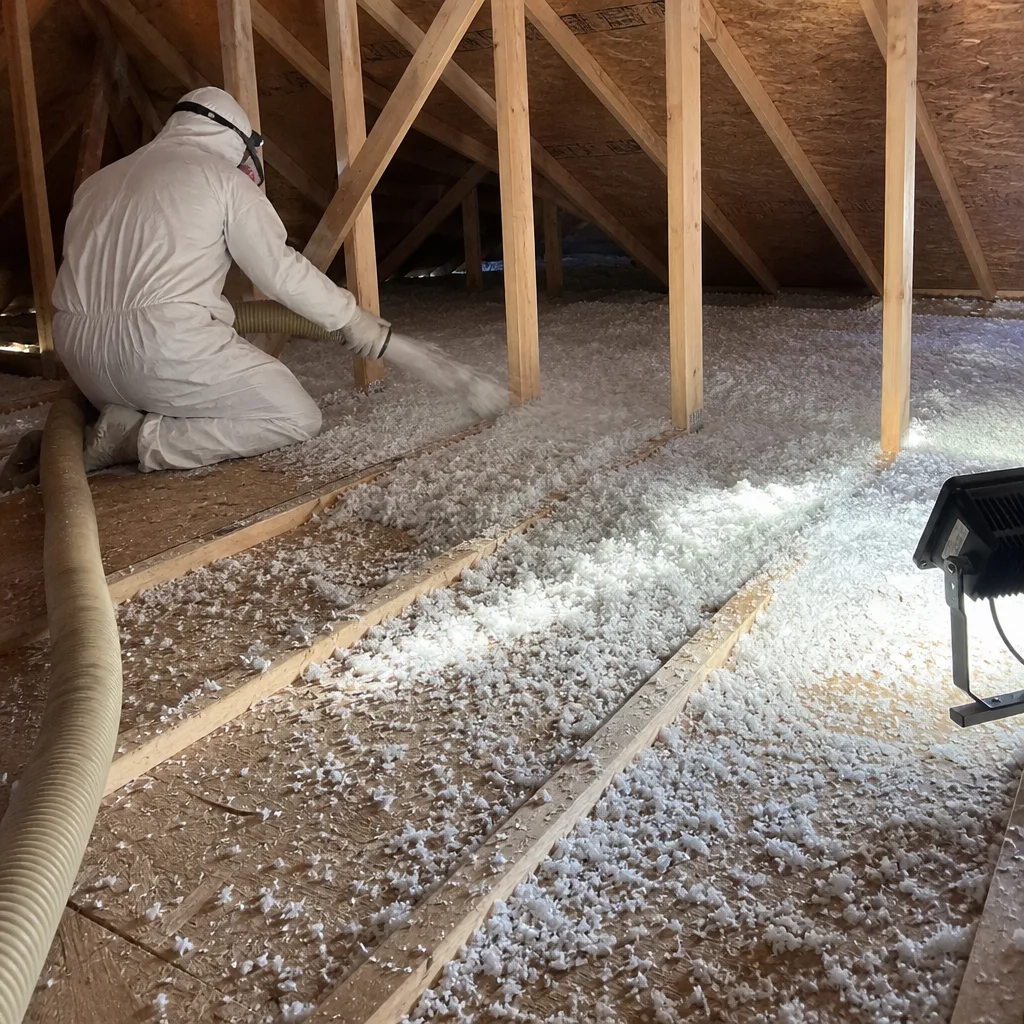
Blown-in insulation refers specifically to loose-fill material, fiberglass or cellulose, blown into place with a mechanical blower. It’s fast, thorough, and fills irregular spaces that batts can’t. Blown-in works best in accessible attic floors, but it’s also useful for dense-packing wall cavities in retrofit situations. The material matters: fiberglass maintains its R-value over time, while cellulose, made from recycled paper treated with fire retardant, fills tighter and provides better air-flow resistance. Both work. The choice depends on the specific attic and the homeowner’s priorities.
Spray foam insulation is applied as a liquid that expands into foam, sealing gaps as it insulates. Open-cell foam is lighter and less expensive, with an R-value around R-3.5 per inch. Closed-cell foam is denser, more expensive, and delivers around R-6 to R-7 per inch with the added benefit of acting as a vapor barrier. Spray foam is the only method that simultaneously insulates and air-seals, making it valuable in attics, crawlspaces, and rim joists. In Stanton, closed-cell foam in the roofline is particularly effective for homes with HVAC equipment or ductwork in the attic, where moving the thermal boundary to the roof deck can significantly reduce cooling load.
The right choice for any given home depends on construction type, existing insulation, budget, and performance goals. That’s the diagnosis-first logic we apply to every Stanton project.
Common Mistakes to Avoid
- Insulating without air sealing first. Adding layers of insulation over an attic full of air leaks is like putting on a puffy coat that’s unzipped. In Stanton, where AC pulls conditioned air through every gap, sealing first doubles the value of whatever insulation follows.
- Assuming the home already has enough insulation. Many Stanton homes built before 1980 have far less than R-19 in the attic, if they have any at all. An inspection takes minutes and often reveals a decades-old assumption was wrong.
- Choosing material by price alone. The cheapest bid usually means fiberglass batts with no air sealing and no attention to even coverage. The initial savings disappear in higher energy bills within two or three Stanton summers.
- Ignoring the attic’s ventilation setup. Insulation changes airflow dynamics in the attic. A properly ventilated attic keeps the roof deck cooler and the insulation dry. Blocking soffit vents with insulation is a common installer error that leads to moisture problems later.
- Treating R-value as the only metric that matters. Air leakage, radiant heat, moisture resistance, and sound attenuation all affect real-world performance. A higher R-value installed poorly will underperform a lower R-value installed well.
- Putting off attic work because winter is mild. The heating season may be short in Stanton, but the cooling season is long and getting longer. Every summer that passes with an under-insulated attic is money spent on AC electricity that insulation would have saved.
- Assuming one material works everywhere. The material that excels in an open attic may be a poor choice for a damp crawlspace or a noise-sensitive interior wall. Application context, not brand preference or price, should drive selection.
When to Call a Professional
Some situations call for a trained eye and professional equipment. If your Stanton home has inconsistent room temperatures with one room running five or more degrees warmer than the rest, you likely have insulation voids or air leaks in specific wall or ceiling cavities. If your energy bills have climbed year over year despite stable utility rates, degraded or missing insulation is a probable cause. If you can see the tops of your attic floor joists, you have less than R-13, which is a significant under-insulation for this climate. If you’ve discovered signs of moisture, mold, or pest activity in the attic or crawlspace, the insulation needs to be assessed for damage and replaced. If recessed lights or can lights in the ceiling are not rated for insulation contact, you need a professional to install protective covers before adding insulation. Warm House Insulation Co offers free estimates in Stanton – call (866) 361-3775 to schedule an attic inspection.
Frequently Asked Questions
For attic insulation in Stanton, R-38 is the practical target for most homes, with R-49 providing additional benefit for homes with high cooling costs or extensive heat transfer through the roof. Wall cavities typically perform adequately at R-13 to R-15 when properly installed and air-sealed. These numbers reflect the cooling-dominant climate of Orange County’s inland areas. Call (866) 361-3775 and we’ll help you determine the right target for your specific home.
Attic insulation for a typical Stanton single-family home ranges from $1,500 to $4,500 depending on square footage, existing insulation depth, and whether air sealing is included. Spray foam costs more per square foot but eliminates the need for separate air-sealing work. Blown-in insulation falls between the two. The exact figure depends on your home’s specific conditions. We provide free estimates so you know the precise number before any commitment.
Yes, and older homes are often where insulation has the biggest impact. Stanton homes built in the 1950s through 1980s typically have minimal or degraded insulation, and bringing them up to modern standards often cuts cooling costs by 20 to 30 percent immediately. The upfront investment typically recovers within three to five years through reduced energy bills. We’ve worked in Stanton homes across every decade of construction and the pattern holds.
Yes, dense insulation materials like Rockwool mineral wool are specifically effective at reducing sound transmission between rooms. Interior walls are usually uninsulated in Stanton homes, and adding mineral wool to bedroom, bathroom, and home-office walls makes a noticeable difference in perceived noise levels. This is a separate benefit from thermal performance and is often the reason homeowners choose mineral wool over other wall-cavity options.
Fiberglass and mineral wool insulation maintain their R-value indefinitely when kept dry and undisturbed, but real-world conditions usually shorten the functional lifespan. Blown-in fiberglass and cellulose compact over time, losing an inch or more of effective depth within a decade. Animal activity, roof leaks, and contractor work in the attic can all degrade insulation. In Stanton, we commonly see attics that haven’t been touched since the original construction, with insulation that’s functionally half its original effectiveness.
Insulation resists heat transfer in both directions, which means it’s just as effective at keeping heat out during Stanton’s long cooling season as it is at keeping heat in during northern winters. In a cooling-dominant climate, insulation’s primary value is reducing the heat load on the air conditioner, which lowers electricity costs and extends equipment life. The notion that insulation only matters in cold climates is one of the most expensive misconceptions in Southern California homeownership.
The Bottom Line
Stanton’s climate demands a different insulation strategy than what national guides prescribe. The attic is where the money is, thanks to the largest temperature differential in the building envelope and a long cooling season that punishes thermal neglect. Air sealing comes first, insulation second, and material selection should follow the specific zone of the home rather than any single product’s marketing. Older Stanton homes carry predictable gaps that are easy to identify and straightforward to fix. The investment is one of the few home improvements that pays for itself through measurable monthly savings within a few years. Whether you need blown-in insulation, spray foam, or a full attic insulation upgrade, start with an inspection. Call (866) 361-3775 for a free estimate.
Written by the team at Warm House Insulation Co, serving Stanton since 2011.