Last updated October 31, 2026
Insulation Cost Breakdown: The Stanton Homeowner’s Reference for 2026
Here’s a number that surprises most Stanton homeowners the first time they shop for insulation: two quotes for the same attic can land $1,600 apart, and the cheaper one is rarely the better deal. The gap usually isn’t profit margin, it’s scope. One contractor quotes insulation only. The other quotes insulation plus air sealing, baffles, debris removal, and a thermal barrier you can actually verify. By the time you finish this guide, you’ll know exactly which line items move the needle on your gas and electric bills, what a fair 2026 price looks like in Stanton’s market, and how to read a quote like somebody who’s done this before.
Quick Answer
Most Stanton homes will pay between $1.50 and $6.50 per square foot for insulation in 2026, with blown-in fiberglass or cellulose at the low end ($1.50 to $3.00 installed), batt insulation in the middle ($2.00 to $4.00), and spray foam at the top ($3.50 to $6.50). A typical 1,200-square-foot attic runs $2,400 to $7,800 total depending on material, R-value target, and whether air sealing and old-insulation removal are included. The single biggest cost variable isn’t what you install, it’s what the quote quietly leaves out.
Table of Contents
- Material Costs by Insulation Type: What You’ll Actually Pay in Stanton
- The Hidden Cost Categories Low Bids Exclude
- Home-Specific Factors That Change the Price
- Why Stanton Labor Rates Look the Way They Do in 2026
- ROI and Payback: Running the Numbers With SCE and SoCal Gas Rates
- How to Read an Insulation Quote Line by Line
- Rebates and Incentives Stanton Homeowners Can Use in 2026
- Common Mistakes to Avoid
- When to Call a Professional
- Frequently Asked Questions
- The Bottom Line
Material Costs by Insulation Type: What You’ll Actually Pay in Stanton
Let’s get the numbers on the table first. These ranges reflect what we’re seeing across Stanton and neighboring Orange County cities in 2026, including material, standard installation labor, and basic site access. They assume a typical single-story home with a standard attic hatch and no major obstacles. Add 15 to 25 percent for two-story homes, vaulted ceilings, or attics crowded with HVAC equipment.
Blown-In Insulation (Fiberglass or Cellulose)
- Material cost per square foot: $0.40 to $0.90
- Installed cost per square foot: $1.50 to $3.00
- Typical R-value: R-30 to R-60 (cellulose tends toward the higher end per inch)
- Best for: Attics with existing insulation that needs topping off, irregular joist spacing, tight access
- Brands we install: Owens Corning AttiCat, Johns Manville Climate Pro, GreenFiber cellulose
Blown-in is the workhorse of the Stanton retrofit market. It’s fast, it fills gaps that batts can’t, and it’s the most affordable way to hit higher R-values in an existing attic. A 1,200-square-foot attic brought from R-11 to R-38 typically runs $1,800 to $3,600. The catch: blown-in does nothing for air leaks. If your quote doesn’t mention air sealing alongside it, you’re paying to filter conditioned air through the same gaps as before, just slower.
Batt Insulation (Fiberglass or Mineral Wool)
- Material cost per square foot: $0.50 to $1.20 for fiberglass, $1.00 to $2.20 for Rockwool mineral wool
- Installed cost per square foot: $2.00 to $4.00
- Typical R-value: R-30 to R-38 for attics, R-13 to R-21 for walls
- Best for: Open attics with standard joist spacing, new construction, noise reduction between rooms
- Brands we install: Owens Corning, Johns Manville, Knauf, CertainTeed, Rockwool
Batts make sense when the attic is clean, accessible, and the framing is conventional. Rockwool mineral wool carries a premium, usually 30 to 50 percent over fiberglass batts, but it earns that premium in three ways: it’s naturally fire-resistant, it blocks sound better than any fiberglass product, and it doesn’t absorb moisture the way fiberglass can. For Stanton homes near busy streets or with bedrooms directly under the attic, the noise difference alone justifies the upgrade for a lot of families.
Spray Foam Insulation (Open-Cell and Closed-Cell)
- Open-cell installed cost per square foot: $1.75 to $3.50
- Closed-cell installed cost per square foot: $3.50 to $6.50
- Typical R-value: R-3.5 to R-3.8 per inch (open-cell), R-6.0 to R-7.0 per inch (closed-cell)
- Best for: Attic rooflines converted to conditioned space, rim joists, crawlspaces, air sealing integrated with insulation
- Brands we install: Icynene (open-cell and closed-cell), Demilec (open-cell and closed-cell)
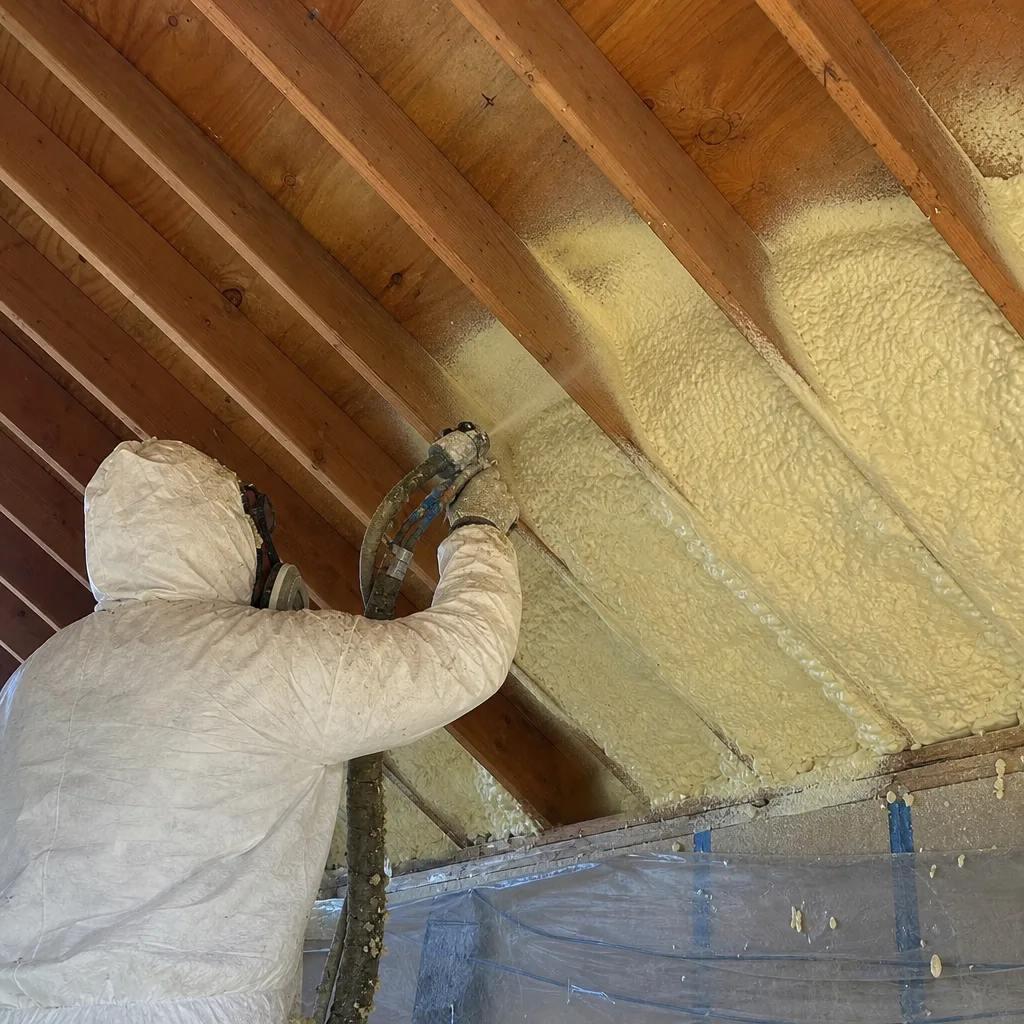
Spray foam is the only insulation that acts as an air barrier and insulation in one step. That’s why it carries the highest material price and the highest payoff in specific applications. In Stanton, where summer attic temperatures routinely exceed 140 degrees on a July afternoon, open-cell Icynene sprayed to the underside of the roof deck turns the attic into semi-conditioned space. Your ductwork stops cooking. Your bedroom ceiling stops radiating heat. For homes with HVAC equipment in the attic, which is most of Stanton’s housing stock built before 2000, that’s a meaningful change that shows up on the first summer electric bill. Learn more about our spray foam insulation in Stanton options.
Radiant Barrier
- Installed cost per square foot: $0.50 to $1.50 (usually stapled to rafters in conjunction with other insulation)
- Best for: Stanton homes with full sun exposure and minimal shade, especially west-facing rooflines
Radiant barrier isn’t insulation in the traditional sense, it reflects radiant heat rather than slowing conductive heat. In Stanton’s climate, with 280-plus sunny days a year, a properly installed radiant barrier under the roof deck can cut attic temperatures by 20 to 30 degrees. It’s almost never worth installing instead of insulation. It’s worth installing with insulation, and most of our attic projects include it when the roofline faces full sun.
The Hidden Cost Categories Low Bids Exclude
This is the section that saves Stanton homeowners real money, because the cost difference between a $1,900 quote and a $3,200 quote usually shows up here. When a bid comes in suspiciously low, one or more of these line items is missing. When you ask about them and the contractor seems confused, that’s your answer.
1. Air Sealing
Air sealing means closing the gaps where conditioned air escapes: top plates, recessed can lights, plumbing penetrations, the attic hatch, flue chases. It’s labor-intensive and invisible afterward, which is exactly why low bidders skip it. But in our experience, air sealing delivers 15 to 25 percent of total energy savings on a typical Stanton retrofit. Insulation without air sealing is like a winter coat with the zipper open. It helps, but you’re still losing heat through the gaps. Air sealing typically adds $400 to $900 to an attic project, and it’s the single most cost-effective line item on any quote.
2. Existing Insulation Removal
If your attic has old, rodent-soiled, water-damaged, or compressed insulation, the right move is removal before new installation. That means vacuum extraction, bagging, and disposal. It typically costs $1.00 to $2.00 per square foot of attic area, so $1,200 to $2,400 on a 1,200-square-foot attic. The problem: some contractors skip removal to stay competitive, then blow new insulation over compromised material. The R-value looks right on paper. The performance isn’t there, and trapped moisture can cause mold you won’t see for years.
3. Soffit Baffles
Soffit baffles are cheap plastic or foam channels that keep insulation from blocking airflow at the eaves. Without them, blown-in insulation drifts into the soffit vents and chokes the attic’s ventilation. Material cost is trivial, maybe $1.50 to $3.00 per baffle. But installation means reaching into the tightest part of the attic, which takes time. Contractors who skip baffles save an hour or two of labor. Six months later, the attic stops breathing, summer temperatures climb, and the homeowner doesn’t know why. A proper attic quote in Stanton includes baffles at every vented bay, full stop. Visit our attic insulation in Stanton page for what a complete attic retrofit should include.
4. Debris Removal and Site Prep
Old storage boxes, broken plywood walkways, dead pests, construction debris. Every attic has something in it. Quotes that assume a “clean attic” are quoting a fantasy. Site prep and debris removal typically add $150 to $400 depending on what’s up there, and it should be a visible line item.
5. Insulation Dams and Barriers
Around recessed lights, bathroom fan housings, and attic hatches, insulation needs to be kept back or contained. This is detail work, and it’s where unlicensed or cut-rate crews cut corners. It adds $100 to $300 to a typical project and prevents both fire hazards and air leaks.
Home-Specific Factors That Change the Price
No flat-rate estimator can honestly price an insulation job sight unseen. Here’s what we look at when we quote a Stanton home, and what each item does to the number.
Attic Height and Access
A 12:12 pitch roof with a 4-foot clearance is an easy workday. A low-slope roof with 18 inches of crawl space is a different job entirely. Crawling through a tight attic in August heat means slower work, more breaks, and higher labor cost. Expect a 10 to 20 percent premium for low-clearance attics. If your attic only has a small scuttle hole instead of a pull-down ladder, add $150 to $400 for access modifications or extended setup time.
HVAC Equipment in the Attic
Most Stanton homes built before 2000 put the furnace and ductwork in the attic, which is terrible for efficiency and complicated for insulation. The equipment sits in the way, needs to be protected during installation, and represents a heat load inside the thermal envelope. Working around HVAC equipment adds 10 to 15 percent to labor. It also means air sealing around duct boots and plenum connections becomes more important, and that’s an extra line item some contractors skip.
Single-Story vs. Two-Story
Two-story homes cost more per square foot to insulate because the work happens in more confined spaces, the hose runs for blown-in are longer, and wall insulation may require drilling from the exterior or working from scaffolding. Figure a 15 to 25 percent premium over single-story pricing for the same square footage.
Knee Walls and Cathedral Ceilings
Knee walls, those short vertical walls between attic space and living space in Cape Cod and split-level designs, are notorious thermal leaks. Insulating them properly requires creating air barriers and often dense-packing with cellulose. Cathedral ceilings leave no attic cavity at all, which means either tearing out the ceiling or using spray foam in the cavity. These conditions add $1,000 to $3,000 to a project, and they’re exactly the situations where a flat-rate “per square foot” quote falls apart.
Age of Home and Framing Irregularities
Stanton’s housing stock spans from 1950s ranches to 1990s tract builds to recent infill. Older framing means irregular joist spacing, settled floors, and insulation cavities that don’t match modern batt widths. Newer homes have tighter air sealing already but often skimped on attic insulation to hit price points. The age doesn’t change the material cost much, but it changes labor, and that’s why we quote after seeing the house, not before.
Why Stanton Labor Rates Look the Way They Do in 2026
Insulation labor in Orange County has climbed steadily since 2021, and 2026 is no exception. There are three reasons. First, California’s prevailing wage floor for public projects drags private-sector wages upward as employers compete for the same installers. Second, insulation work is physically demanding and increasingly hard to staff, which means qualified installers command higher pay. Third, California’s licensing and workers’ compensation requirements add overhead that legitimate contractors carry and unlicensed operators don’t.
That third point matters when you’re comparing quotes. A licensed, insured, workers’ comp-carrying insulation contractor in Stanton is paying roughly 25 to 40 percent more in overhead than an unlicensed crew working cash. That overhead shows up in the price. It also shows up in what happens if a worker gets hurt on your property, or if the job fails inspection. We’ll put it simply: the cheapest quote you receive is often from someone who isn’t carrying the insurance and licensing that protects you, and that discount is never worth the liability exposure.
What should you expect for labor specifically? In Stanton’s 2026 market, insulation installation labor runs $45 to $85 per hour per installer depending on the method and the company. A two-person crew doing a full attic retrofit over a day and a half is $1,100 to $2,000 in labor alone. When a quote comes in under that, the contractor is either cutting scope or cutting corners.
ROI and Payback: Running the Numbers With SCE and SoCal Gas Rates
The question every Stanton homeowner actually wants answered: “Is the more expensive option worth it?” Here’s how to figure that out for your house using the rates you actually pay.
Step 1: Find Your Baseline Energy Use
Pull twelve months of bills from Southern California Edison and SoCal Gas. Note your summer cooling costs (June through October) and winter heating costs (December through February). A typical 1,500-square-foot Stanton home with poor attic insulation spends $250 to $450 per month on combined energy in peak summer and $150 to $250 in winter.
Step 2: Estimate Savings by Scenario
- Blown-in upgrade from R-11 to R-38 with air sealing: 20 to 30 percent annual HVAC savings
- Batt insulation at R-38 with air sealing and radiant barrier: 25 to 35 percent
- Open-cell spray foam on the roofline (attic converted to conditioned space): 30 to 45 percent, higher if ductwork is in the attic
These ranges assume your home’s other systems are functioning normally. If your ducts leak badly, insulation savings will underperform until ducts are sealed, and that’s a separate scope. A honest contractor tells you that before quoting.
Step 3: Calculate Simple Payback
Take the installed quote, subtract any rebate you’ll collect (see below), and divide by annual savings. Here’s the math for a typical Stanton ranch home:
- Project: 1,200-square-foot attic, blown-in to R-38, air sealing, baffles, debris removal
- Quote: $3,400
- Rebate: $300
- Net cost: $3,100
- Annual savings: $420 to $630
- Payback period: 5 to 7 years
Now run the same house with spray foam on the roofline at $5,800 net. Annual savings climb to $700 to $900 for the right house, but payback stretches to 6 to 8 years. The spray foam adds comfort and noise reduction that don’t show up in a payback calculation. Whether that’s worth it depends on how long you plan to stay in the house and how much the attic affects your daily comfort. We walk through both scenarios on every estimate, because the home’s needs drive the recommendation, not whichever product we’d prefer to sell.
How to Read an Insulation Quote Line by Line
Most Stanton homeowners compare the bottom line. That’s the wrong number to look at first. Here’s the order we tell people to read a quote in:
- Scope line items first. Does it list air sealing? Baffles? Removal of existing insulation? Debris disposal? Insulation dams around fixtures? Every missing line is cost you’ll pay later, either in a change order or a poorly performing attic.
- Material and R-value second. “Blown-in fiberglass” without an R-value is an incomplete quote. “Spray foam” without open-cell or closed-cell specified is incomplete. “Batts” without a brand and R-value is incomplete. Ask for R-value in writing.
- Labor and access assumptions third. Does the quote state the attic clearance, access method, and whether two-story or equipment obstructions are accounted for? If the quote says “assumes clean, accessible attic,” ask what happens if it isn’t.
- Warranty and license information fourth. Is the contractor’s California license number on the quote? Is insurance documentation available? A serious insulation contractor in Stanton provides both without being asked.
- Bottom line last. Compare totals only after the first four checks pass. That’s how you avoid hiring the contractor who quoted the insulation and forgot to mention the rest of the job.
One more thing: get the quote in writing, and get it itemized. Verbal quotes in this industry have a way of growing on installation day. An itemized written quote protects both parties and tells you the contractor has actually thought through your specific attic.
Rebates and Incentives Stanton Homeowners Can Use in 2026
California’s incentive landscape changes frequently, but as of 2026, Stanton homeowners have access to several programs that reduce net insulation cost. The key is applying them to the net cost, not just subtracting them from the gross quote and calling it done.
SCE Attic Insulation Rebate
Southern California Edison has historically offered attic insulation rebates in the $0.15 to $0.30 per square foot range for qualifying upgrades, typically requiring a minimum R-value increase. The rebate fluctuates by year and funding availability, and it’s worth checking SCE’s current program before you quote. A 1,200-square-foot attic could qualify for $180 to $360.
SoCal Gas Energy Savings Assistance
For income-qualified households, SoCal Gas offers free or heavily subsidized attic insulation through their ESA program. If your household qualifies, this is the single largest cost reduction available, covering the full project cost in many cases. Not everyone qualifies, but everyone should check.
California Energy-Smart Homes and Local Programs
Stanton falls under Orange County’s regional efficiency programs, which occasionally offer insulation incentives through the county or through third-party administrators. These programs tend to be under-advertised. Our team tracks them and flags applicable rebates during the estimate process, because the net number is what actually matters to your budget.
IRA Home Energy Rebates
The Inflation Reduction Act’s Home Efficiency Rebates (HER) program is rolling out in California with insulation as a qualifying measure. Income-eligible households may qualify for point-of-sale discounts up to several thousand dollars depending on the income tier and the measured energy savings. Implementation timelines have shifted, so verify current status before budgeting around this one.
The takeaway: your gross quote minus available rebates is the real number to compare. Two identical quotes with different rebate eligibility can swing the net cost by $300 to $1,000 or more. We include rebate research in every estimate we do for Stanton homes, and we recommend you ask any contractor you’re considering to do the same.
Common Mistakes to Avoid
- Comparing quotes by total price alone. A $1,900 quote and a $3,200 quote for the “same attic” are almost never the same scope. Read line items first, total last. The cheap quote is cheap because something essential is missing.
- Assuming existing insulation is fine to build on. Insulation that’s been wet, packed down by rodents, or compressed from decades of heat loses most of its R-value. Building over it without removal just seals the problem underneath. Get the attic inspected before deciding.
- Skipping air sealing because it isn’t “insulation.” Air sealing delivers outsized savings per dollar spent. Insulation without air sealing is half a job, and we see it in Stanton attics every week. A quote without air sealing is a quote for a partial project.
- Choosing material by lowest square-foot cost only. Blown-in fiberglass is the cheapest installed insulation per square foot. It’s also not an air barrier, provides minimal sound attenuation, and settles over time. The right material is the one that fits the application, not the one with the lowest sticker price.
- Not confirming soffit baffles are included. Skip baffles and you’ll have a well-insulated attic with no ventilation. That combination cooks shingles, spikes summer cooling costs, and can void roofing warranties. It’s a $200 line item that prevents thousands in problems.
- Ignoring the attic hatch. An uninsulated, unsealed attic hatch is a two-foot-square hole in your thermal envelope. It’s the last thing insulated and the first thing that leaks. A proper attic job includes weatherstripping and an insulated hatch cover.
- Not verifying licensing and insurance before signing. Unlicensed insulation work in California carries real risk: no workers’ comp coverage for injuries on your property, no contractor’s bond for failed work, no license board to file a complaint with. Verify the license number before you pay a deposit.
When to Call a Professional
Some insulation projects are straightforward enough for a capable DIYer. Most aren’t, and the line is usually clear. Call a professional when: the attic has existing insulation that needs removal, which requires commercial vacuum equipment and proper disposal; the job involves spray foam, which requires specialized equipment, chemical handling training, and PPE; the home has old wiring, knob-and-tube, or recessed lights that need fire-safe treatment; the attic is tight, low-clearance, or full of HVAC equipment; or you’re simply not sure what R-value your home needs for Stanton’s climate zone. A professional assessment costs nothing when the contractor offers free estimates. Warm House Insulation Co offers free insulation estimates in Stanton, call (866) 361-3775 to schedule yours.
Frequently Asked Questions
Most Stanton attics cost between $1,800 and $5,500 to insulate depending on square footage, material selection (blown-in at the low end, spray foam at the high end), and whether air sealing and removal of existing insulation are included. A typical 1,200-square-foot attic with blown-in insulation, air sealing, and baffles runs $2,800 to $4,200. Call (866) 361-3775 for an exact quote on your attic, estimates are free.
Blown-in fiberglass is the lowest-cost effective insulation option for Stanton attics at $1.50 to $3.00 per square foot installed, and it performs well when paired with air sealing and proper baffling. Skip air sealing to save money and you’ll lose a big share of the material’s performance, which makes a cheap material expensive in the long run.
Insulating the attic floor is almost always cheaper, typically $1.50 to $4.00 per square foot versus $3.50 to $6.50 for spray foaming the roofline. Roofline insulation makes sense when HVAC equipment and ductwork live in the attic and you want them inside the conditioned space, a common setup in older Stanton homes. It costs more upfront but delivers bigger comfort and efficiency gains in those specific houses.
Yes. A properly sealed and insulated attic typically cuts cooling costs by 20 to 35 percent in Stanton’s summer months, when attics can reach 140 degrees and force your AC to run constantly. The exact savings depend on your current insulation level, your ductwork condition, and how much air leaks through your attic floor.
Remove existing insulation when it’s water-damaged, rodent-soiled, compressed to less than half its original depth, or contaminated with mold. Top off with new blown-in insulation when the existing material is dry, clean, and just under the R-value you need. A visual attic inspection answers this in about ten minutes, and any honest contractor includes that inspection in the estimate.
Most Stanton insulation projects can be scheduled within one to two weeks of the estimate, sometimes faster depending on our crew schedule and the scope. Small attic top-offs are often same-week jobs. Larger projects involving removal, air sealing, and spray foam take a bit longer to schedule. Call (866) 361-3775 and we’ll give you a no-obligation estimate and realistic timeline.
The Bottom Line
Insulation quotes in Stanton vary by 40 to 60 percent for the same square footage because they’re frequently not quoting the same work. The difference between a $1,900 job and a $3,200 job is visibility: air sealing, baffles, removal, hatch covers, and the R-value you’ll actually get. Read quotes line by line. Compare net cost after rebates, not gross totals. Choose material by what your home needs, not by the lowest square-foot price. Our Warm House Insulation Co home approach is built around that principle, matching the right method from attic insulation, spray foam, or blown-in insulation to the house in front of us. A well-insulated Stanton home is cooler in July, quieter every day, and cheaper to run every month. That’s worth doing right the first time.
Written by the team at Warm House Insulation Co, serving Stanton since 2011.