
Last updated October 31, 2026
Seasonal Insulation Care for Stanton: Year-Round Homeowner’s Guide
Most insulation guides are written for places with real winters. Stanton gets maybe three nights a year below 40 degrees, so the usual advice about “winterizing” your attic reads like it was written for a house in Cleveland. But Stanton has its own seasonal rhythm, and it puts real stress on insulation. The Santa Ana winds that sweep through in September and October do more damage to attic insulation than any cold snap, because rapid pressure cycling pulls unconditioned air through gaps most homeowners don’t know exist. This guide walks through the four thermal stress periods that actually matter in Stanton, what to check during each one, and how to build a maintenance record that pays off when you sell. For Attic Insulation Maintenance Checklist for Stanton Homeowners, see our detailed checklist.
Quick Answer
Seasonal insulation care in Stanton means four targeted checkpoints: a pre-summer attic inspection in April or May, an air-sealing review during Santa Ana season in September through November, a condensation check on cool winter nights in December through February, and a post-rain moisture inspection in March and April. The goal each season is to catch air leaks, moisture intrusion, and insulation settling before they turn into higher energy bills or hidden damage.
Table of Contents
- Pre-Summer Attic Check (April to May): The Highest-Value Inspection Window
- Santa Ana Season (September to November): Wind-Driven Air Sealing
- Winter Nights (December to February): Condensation, Not Roof Leaks
- Spring Post-Rain Inspection (March to April): Quiet Moisture Migration
- Building a One-Page Home Log: Your Resale-Ready Maintenance Record
- Common Mistakes to Avoid
- When to Call a Professional
- Frequently Asked Questions
Pre-Summer Attic Check (April to May): The Highest-Value Inspection Window
The weeks before Stanton’s late-summer heat peaks are the single most valuable time to inspect your attic. Here’s why: insulation problems are easiest to see before the attic becomes a 140-degree oven, and any fix you make in April or May pays off through the entire cooling season. Once June hits and your air conditioner starts running daily, a compromised attic means you’re paying to cool air that escapes through the ceiling into unconditioned space. Most Stanton homes we look at have some version of this problem, and the owners don’t realize it until the August utility bill arrives.
What to Check Before Cooling Loads Peak
- Insulation depth and settling. Fiberglass batts and blown-in cellulose both settle over time. If your attic insulation looks thin or patchy, it’s not doing what it did when it was installed. In Stanton, where attic temperatures routinely exceed 130 degrees in August, every inch of insulation depth matters. The recommended R-value for attic insulation in Southern California is R-30 to R-38. If you can see the tops of your ceiling joists, you’re under-insulated.
- Gaps around ceiling penetrations. Recessed lights, bathroom fans, and attic access hatches are the usual suspects. Warm air from your living space rises and finds these gaps all year, but it matters most in summer, when every cubic foot of conditioned air that escapes is replaced by hot outdoor air your AC has to cool. A tube of caulk or a few cans of expanding foam around these penetrations is one of the cheapest fixes in all of home maintenance.
- Bathroom fan ducting. If your bathroom fans vent into the attic instead of through the roof, that’s warm, moist air being pumped directly onto your insulation every time someone showers. In Stanton’s mild climate, this doesn’t always cause visible problems immediately, but over years it compresses fiberglass, degrades its performance, and can create mold on the sheathing. This is exactly the kind of issue that gets found during a pre-sale inspection and costs the seller money.
- Pest activity. Rats and mice love attics in Stanton, particularly in older neighborhoods near mature trees. Rodents tunnel through insulation, compress it, and leave droppings that contaminate the material. If you see signs of nesting or droppings, address the pest issue before adding insulation. Blown-in insulation installed after a rodent exclusion is the standard fix we recommend.
If any of this sounds like a project you’d rather not climb a ladder for, our attic insulation service in Stanton includes a full inspection. We’ll tell you what’s wrong, what’s urgent, and what can wait.
Santa Ana Season (September to November): Wind-Driven Air Sealing
Santa Ana winds are the most underappreciated threat to home insulation in Stanton. Here’s the mechanism: when high-pressure air over the Great Basin pushes toward the coast, it creates sustained winds that can gust over 50 mph. As wind flows over your roofline, it creates negative pressure inside the attic, which actively pulls conditioned air out of your living space through every gap in the ceiling plane. The wind pressurizes the attic from outside while depressurizing it from above, and the result is a constant one-way exchange of air you paid to heat or cool.
Why Insulation Alone Can’t Fix Wind-Driven Infiltration
This is the point most homeowners miss, and it’s the reason some Stanton homes still feel drafty in October even with decent attic insulation. Fiberglass and cellulose slow conductive heat transfer. They do not stop air movement. Air moves through insulation. Wind-driven air moves through it faster. The fix for a drafty house during Santa Ana season is air sealing: closing the gaps in the building envelope so air can’t move through, around, or behind the insulation. If you’re still seeing issues, our Attic Insulation Troubleshooting: Common Problems and How to Fix Them covers next steps.
Signs Your Home Has an Air Sealing Problem During Santa Ana Season
- You smell dust or dry earth inside your home when the wind picks up.
- Curtains move slightly even with windows closed.
- Rooms on the leeward side of the house feel noticeably warmer or cooler than the windward side.
- Your heating system cycles more often on windy days, even when outdoor temperatures haven’t changed.
- You hear wind noise near outlets, light switches, or crown molding.
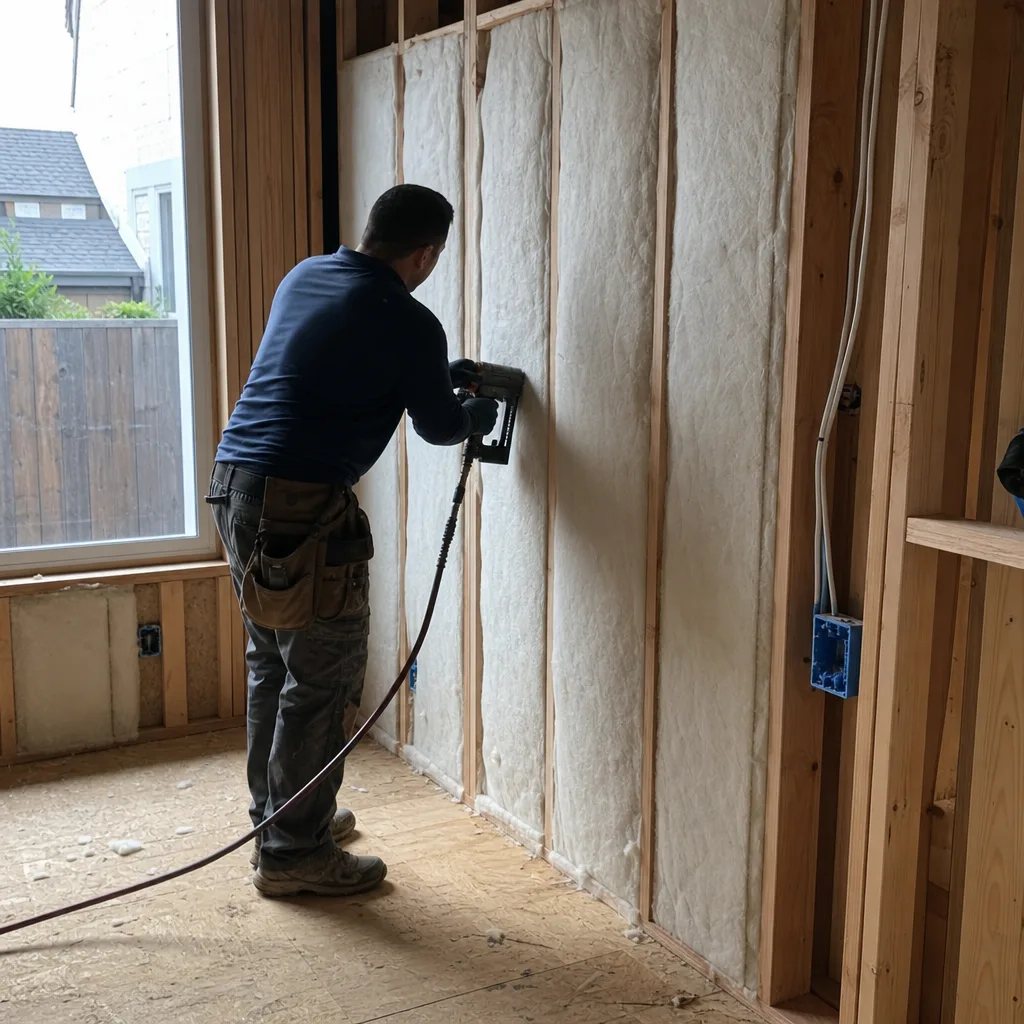
Spray foam is the most effective air-sealing material we work with, and it’s one reason we install both Icynene and Demilec systems. Open-cell foam in particular excels at air sealing an attic roofline, turning the attic from a vented, wind-exposed space into a conditioned part of the home. For Stanton homeowners who’ve already done basic air sealing and still feel drafts in October, converting to an unvented attic with spray foam is often the solution that finally works. You can read more about the approach on our spray foam insulation page for Stanton.
Winter Nights (December to February): Condensation, Not Roof Leaks
Stanton’s winter nights rarely drop below 45 degrees, and that creates a condensation problem homeowners in colder climates don’t experience the same way. Here’s what happens: during the day, your attic warms up to 70 or 80 degrees, and the air inside it holds a lot of moisture. At night, the roof deck cools rapidly. When warm, moist attic air contacts the cold sheathing, water vapor condenses on the underside of the roof.
In a properly vented attic, this condensation evaporates the next day. In an under-ventilated attic, which describes a large share of Stanton’s older housing stock, the condensation drips onto the insulation or runs down the rafters. Homeowners see water stains on the ceiling and assume they have a roof leak. Often, the roof is fine. The problem is moisture that built up inside the attic because the space can’t breathe.
How to Tell the Difference Between a Roof Leak and Attic Condensation
- Check the weather pattern. Roof leaks show up during or immediately after rain. Condensation stains appear during dry, cool spells, typically a night or two after a temperature drop.
- Look at the stain location. Roof leaks are often localized, near flashing, penetrations, or valleys. Condensation is more diffuse, showing up across broad areas of the ceiling, especially near exterior walls.
- Inspect the attic during the day. If you go up on a dry afternoon and find moisture on the underside of the roof deck or damp insulation, that’s condensation. Rain from a week ago would have dried by then.
- Feel the insulation. Insulation dampened by condensation feels cooler to the touch and appears flattened or matted, even if it was fluffy a few months earlier.
Ventilation fixes this problem, and so does reducing the amount of moisture that reaches the attic in the first place. Bathroom fans, kitchen range hoods, and dryer vents all need to terminate outside, not in the attic. Blown-in insulation can also help, because it’s installed to a consistent depth that reduces thermal bypass, but only if the ventilation is already adequate.
Spring Post-Rain Inspection (March to April): Quiet Moisture Migration
By the time March rolls around, Stanton has typically received most of its annual rainfall, and the ground around your foundation is holding moisture. This is the season when crawlspace and wall-cavity moisture problems reveal themselves. Not dramatically, the way a roof leak does. Quietly, through damp smells, slightly warped baseboards, or a musty odor that appears when the weather warms up.
The Crawlspace Check
If your Stanton home has a raised foundation, the crawlspace is the first place spring moisture shows up. Here’s the inspection sequence we follow:
- Check for standing water or saturated soil. After a wet winter, the earth under your house can stay damp for weeks. If you see pooling water, that’s a drainage issue that needs attention before insulation work.
- Inspect the underfloor insulation. Fiberglass batts held in place by wire rods or netting often sag after exposure to moisture. A sagging batt creates an air gap that kills its thermal performance. If your floors feel cold in March even though the outdoor temperature is mild, this is likely why.
- Look for vapor barrier condition. A torn or missing vapor barrier on the crawlspace floor lets ground moisture evaporate directly into the underfloor space. Replacing it is inexpensive and immediately reduces the humidity load on your insulation.
- Check rim joists. The rim joist, the perimeter board that sits on top of the foundation wall, is a notorious air and moisture leak point. In Stanton’s older homes, rim joists are rarely insulated or sealed. Sealing them with spray foam cuts off a significant pathway for both outdoor air and moisture.
The Wall Cavity Check
Wall cavities are harder to inspect directly, but spring is the season when signs become visible from inside the house. Warped or discolored baseboards, bubbling paint near the floor, or a persistent musty smell in a specific room all suggest moisture has migrated into the wall cavity. If you’ve had these symptoms for more than one spring, it’s worth having the wall cavity evaluated. Moisture that lingers in a wall cavity degrades whatever insulation is in there and can lead to mold.
For crawlspace and wall work, we often specify closed-cell spray foam from Demilec or Icynene, because closed-cell foam acts as a moisture barrier while also insulating. See our guide on Choosing the Right Insulation Brand: A Buyer’s Guide for Stanton for more on material selection. It’s a material choice that solves two problems at once, and it’s one of the reasons we keep both brands on the truck.
Building a One-Page Home Log: Your Resale-Ready Maintenance Record
You don’t need a spreadsheet. A single page in a notebook, or a note on your phone, is enough. The point is to record when you checked, what you found, and what you did about it. Here’s the format we suggest:
- Date and season. Write the date and which of the four Stanton thermal stress periods you’re in.
- What you checked. Attic insulation depth, air sealing around penetrations, ventilation, crawlspace moisture, signs of condensation or pest activity.
- What you found. Be specific. “Insulation settled to 6 inches in northwest corner” is useful. “Attic looks fine” is not.
- What you did. Note the action taken, the material used, and the date of completion.
- Next check. Every entry ends with the next date you plan to look.
When you sell a Stanton home, buyers and their inspectors ask about maintenance history. A one-page log that shows four years of seasonal insulation checks signals that the house was cared for by someone who understood it. For more guides & resources on home maintenance, visit our blog. That’s worth real money at closing, and it costs you ten minutes per season.
Common Mistakes to Avoid
- Waiting until the attic is already hot to inspect it. By July, a Stanton attic can hit 130 degrees. Inspections happen in April and May because that’s when you can spend more than five minutes up there and actually see what you’re looking at.
- Treating condensation stains as roof leaks without checking the attic first. We’ve seen Stanton homeowners pay for roof repairs they didn’t need because a contractor looked at the ceiling and didn’t look at the attic. Before you hire a roofer, go up and feel the insulation.
- Adding insulation without air sealing first. R-value is only part of the equation. If air moves through the ceiling plane freely, new insulation on top of the old won’t deliver the comfort or savings you’re paying for. Seal first, then insulate.
- Blocking soffit vents when adding insulation. Soffit vents are how outside air enters the attic to replace the warm, moist air that exits through the roof vents. Cover them with blown-in insulation and you’ve created a hot, stagnant attic that breeds condensation.
- Ignoring the crawlspace because no one sees it. Crawlspace moisture doesn’t stay in the crawlspace. It migrates upward through floor framing and into living spaces. Spring is the season to check it, and the check takes fifteen minutes.
- Pushing insulation against recessed light fixtures. Unless the fixture is rated IC (insulation contact), insulation must be kept away from it. This is a fire safety issue, and it’s also a code requirement. If you see insulation heaped around old can lights, pull it back.
- Assuming one insulation type works everywhere. Fiberglass works well in walls and vented attics. Spray foam is the right call for air sealing and unvented assemblies. Blown-in cellulose is excellent for retrofit attics. The right material depends on the specific situation, not the brand the installer happens to carry.
When to Call a Professional
Some checks are safe for any homeowner to do. Others aren’t. If you’re comfortable on a ladder and your attic has a solid floor or wide joist spacing, a visual inspection is reasonable. But call a professional if you see mold, extensive rodent damage, or moisture that has soaked into insulation. Those situations require removed material, not just added material. If you have an unvented attic and you’re seeing condensation, the fix involves spray foam and potentially mechanical ventilation, and that’s not a DIY project. Warm House Insulation Co offers free estimates in Stanton, and we’ll tell you honestly whether the problem is something you can handle yourself or something we should take on. Call (866) 361-3775.
Frequently Asked Questions
Twice a year is enough for most Stanton homes: once in April or May before summer cooling loads peak, and once in September or October when the Santa Ana winds start blowing. The spring check focuses on insulation condition and moisture from winter. The fall check focuses on air sealing and wind-driven infiltration. Homes with known issues, like a history of condensation or pest activity, benefit from a third check in January or February.
Santa Ana winds don’t damage insulation directly the way rain does. What they do is expose air leaks in your building envelope. Wind pushing against your home creates pressure differences that pull conditioned air through gaps around ceiling fixtures, attic hatches, and wall plates. If your home feels drafty or dusty during Santa Ana events, the problem is air sealing, not insulation thickness. Call us at (866) 361-3775 for an evaluation, and we’ll pinpoint the exact leak paths.
For Stanton’s climate, R-30 to R-38 in the attic is the recommended range. Most older Stanton homes we inspect have R-19 or less, often unevenly distributed. The good news is that adding blown-in insulation to reach R-38 is one of the most cost-effective home improvements available, typically paying for itself within a few years through lower cooling bills.
Water stains that appear during dry weather are almost always attic condensation. Warm daytime air in the attic holds moisture, and when temperatures drop at night, that moisture condenses on the cold roof deck and drips onto the ceiling. Poor attic ventilation is the usual cause, sometimes combined with bathroom fans or dryer vents that exhaust into the attic. The fix is ventilation and proper exhaust termination, not roof repair.
Spray foam earns its cost in Stanton primarily through air sealing, which reduces both energy bills and dust intrusion during Santa Ana season. Closed-cell foam, like the Demilec and Icynene closed-cell products we install, also acts as a moisture barrier in applications like crawlspaces and rim joists. It’s not the right material for every situation, but it’s the right material for specific problems that fiberglass and cellulose can’t solve.
In most cases, yes. Blown-in fiberglass or cellulose can be installed directly over existing batts or loose fill, provided the old insulation is dry, uncontaminated, and free of pest damage. What you should not do is add insulation over moldy or rodent-infested material, or over recessed lights that aren’t rated for insulation contact. Those issues need to be addressed first. A professional inspection will tell you whether your existing insulation is a suitable base.
The Bottom Line
Stanton’s insulation challenges aren’t about extreme cold. They’re about heat, wind, and moisture, each arriving on its own schedule. Pre-summer heat exposes thin, settled insulation and forces your AC to work overtime. Santa Ana winds exploit every air gap your home has. Winter nights turn under-ventilated attics into condensation chambers. And spring rains reveal crawlspace moisture that’s been building quietly for months. Checking at the right time, in the right order, catches problems when they’re still cheap to fix. A one-page log turns those checks into a record that protects your home’s value. And when a fix is beyond what you want to tackle yourself, Warm House Insulation Co is a local Stanton company that can handle it, with the material range to match the fix to the problem.
Written by the team at Warm House Insulation Co, serving Stanton since 2011.